Monday, December 20, 2021

The Coad Table Idealist and Realist Agree: Time for a Change of Direction

Earlier this week ten friends gathered for the first time after nearly two years of Zooming, to renew and re-launch an in-person Coad Table. 

The Coad Table . . . 
. . . meets every six weeks to discuss our response to and responsibilities in international affairs. The group is named in honor of Tom Coad who with Don McLaren founded the group years ago as a monthly, over-dinner discussion. Both Don and Tom were past-Presidents of the World Affairs Council; Tom’s particular interests were over-population and nuclear hegemony. Don’s, the forging of collaborative efforts to address conflict. Both, sadly, are gone but their legacy of concerns is carried on by fifteen or so of us old white guys. (Care to join? Give me a call. The younger and more colorful, the better.) 

Climate Change 
Last Tuesday, our impossibly broad subject was climate change and global warming. Eight of us catalogued the obstacles to meeting the +4°F Paris and Glasgow goal, but implicitly accepted that our course was to proceed and overcome those obstacles, as difficult and unlikely as that might be. Two of us, I in this camp, demurred: the war on global warming has been lost; it’s time for a change in direction. 

The Global Warming War Has Been Lost 
At risk of being called defeatist and isolationist, both of which labels I reject, let me argue my view. First, we already have used up half of the +4° leeway set in Paris at COP 21 (the United Nations Climate Change Conference, 2015) and re-affirmed at last month at Glasgow. We are more than +1°C (1.6° F) above pre-industrial 1890 temperature on average, and some areas of the world ahead of that. A neat way to see what’s happening around the world is to open and peruse these quick, “post card” bites of information on climate experiences in each UN member nation 

Second, the developed nations’ 2015 pledges of financial support for lesser developed nations have not yet been paid. The need for and costs of investment escalate as global warming proceeds. We aren’t about to catch up. 

Third, the developed world does not exhibit the will needed to dramatically move to zero emissions. Mandates are eschewed; carbon tax proposals are shelved. One of our Coad Table guys observed that there are three parts to the puzzle: the natural, long cycles of earth’s evolution; our man-made environment and technological change; and the social compact to act together. We can’t control the first. We may have some better tools coming on stream, such as batteries for storing wind and solar power, new methods for re-cycling water and minimizing fresh water usage, etc. Bill Gates, writing in his latest Gates Notes blog, holds out hope for technological silver bullets, mainly in energy generation, that will get us to net-zero by 2050. 

But the roadblock is that social element: the will to undertake drastic, bold action. There is no prospect for marshalling such will world-wide, nor among the top five polluting economies – the US, China, India, EU, and Russia. We will be +4°F long before 2050. The war on global warming has already been lost. There is going to be more destruction, increasing dislocation, growing distress. The US strategy must now change and focus on our own welfare. This doesn’t mean abandoning the world but first making sure that as few as possible of our own become climate war victims. 

A Change of Direction 
Last week, I attended a World Affairs Council panel discussion on what local companies were doing on climate change. On the panel were the top climate change officers (with various titles) of Boeing, Amazon, Microsoft, and Alaska Airlines. The four talked about re-cycling; cutting use of plastics; using renewable sources of energy; developing “sustainable aviation fuel” (whatever that is); converting to electric vehicle fleets; constructing green buildings; and so on – all good things in pursuit of forestalling global warming. 

When question time came, I asked “if your CEO or board directed you to focus on anticipating, avoiding, and mitigating damage from climate change, how would that change what you do? It was four deer caught in the headlights – motionless, staring, silent. Finally, Amazon’s Chris Davis, Sr. Mgr., Sustainability Policy, said something like this: we’d have to start with and really step-up risk assessment. Mind: this was two days before the tornados in Tennessee and Kentucky, one of which flattened an Amazon distribution center, killing six employees. 

What dangers? 
Prepping for the Coad Table discussion, I listed for myself nine categories of climate damages and dangers to the US, and some steps that might be taken. Were we to try nothing, chaos, destruction and distress are guaranteed. Here is my list, in no particular order, which means Davis, of Amazon, nailed it: risk assessment is key to sorting out goals and priorities: 
• Water -- Ocean level 
    Develop and install estuary gates a la Netherlands and Venice 
    Protection and renovation of locks, docks, cargo piers 
    Levees to be raised and, in some cases, removed to restore wetlands as storm water diversion 
    Zoning and insurance
        No re-building on barrier islands and coastal plains – as homes destroyed, no replacement 
        State insurance commissioners use punitive rates to re-locate populations 
        Subsidized re-location programs 
• Water – storm surge 
    Increase capacity of storm drain systems 
    Protection of industrial plants – especially nuclear and other power plants 
    Protection of city infrastructure 
        Levee subway accesses 
• Drought 
    Watershed process for resolving allocation issues 
    Desalinization plant investment 
• Wildfires 
    Zoning in unincorporated areas
    Increasing manpower and capacity of forest fire fighting orgs 
    Fireproofing electrical grids 
• Fertility zone changes 
    Beef up USDA county Ag Agents 
    Increase funded crop research 
• Frequent and severe storms: tornados, hurricanes, thunderstorms 
    Power and Grid vulnerability 
    Industrial Plant vulnerability 
    Catalog high potential damage zones 
• Migration 
    Guest worker program 
    Climate refugee rights accord 
    Interdiction of illegal immigration 
• Domestic terrorism and cultural conflict 
• Species extinction and diversity 
    Weight in risk assessment? 
    Protection of ranges in face of migration and new fertility zone pressures  

A New Direction 
Such enormous projects of risk assessment, damage avoidance, mitigation and emergency response require a national consensus and extraordinary leadership to forge it. Some of Coad Table group cautioned that autocracy and armed forces enforcement might be called for. But autocracy is not required if a consensus on the threat to the commonweal and a clearly defined purpose can be articulated and a compelling call to patriotism be made. This doesn’t mean stopping research into clean energy and carbon footprint reduction; it does mean setting new priorities and undertaking new investments and expenditures at local, state and federal levels. 

How will all this be paid for? First, weight priorities for the new infrastructure authorization toward projects that have climate damage mitigation effects.  Next: how about forgoing the ten-year, $3 trillion ICBM modernization program, decommissioning that third and increasingly obsolete leg of the triad, and relying on submarine-launched nukes and air-launched cruise missiles and strategic bombing as our deterrents? Freeing up $300 billion a year will go far to paying the bill for a comprehensive climate damage strategy. Reducing the risk of unintentional nuclear exchange would be a welcome dividend. 

Does this mean turning inward and isolationist? Not necessarily. How about curtailing all military assistance programs and replacing them dollar for dollar with climate disaster preparation assistance? That would buy a far larger and more valuable impact. How about closing the War College and creating a Climate Adaptation College for both domestic and foreign designees? 

The Third Label . . . 
. . . I will be tagged with is alarmist. Yes; the alarm bells need to be rung. I am alarmed. Now a third of the way round my 88th orbit of the Sun, I likely won’t be here to see what happens, but your and my children will be. Our grandchildren are potential victims. And my great-grandchildren? 

And the Fourth Label? Idealist 
OK, guilty. My friend Bill R recently said “when you are confronted with an idealist, run for your life!” But we have no place to run to. All I’ve suggested here is feasible even though unlikely. 

Bill is a realist. But Bill and Fletch, the realist and the alarmed idealist, were the two Coad Table outliers who said climate change is here; the war to forestall global warming is already lost; it’s time for a change of priority. And that change is to ring the alarm and engage Americans in a crusade to mitigate the damage that global warming is already beginning to wreak upon us. 

PS If you find this provocative, pass it along to an acquaintance, preferably one of those Gen Z’ers who will inherit this mess we’ve been making. They are the promising ones of passion and idealism.

Sunday, November 21, 2021

Connections Enmesh

Life and art and death and ceremony – over the last three weeks, separate threads have woven about me a web of connections, a net not unlike that in which Moby Dick ensnared Fedallah, the shaman. Moby Dick?! Yes, Moby Dick.

The G.A.N?

All began when I read a NYT review of Albert and The Whale in which Philip Hoare explores fabulous animals in renaissance art, the genius of Durer, the mystery of the whale. Hoare, a British polymath, follows rabbit trails into art history, German literature, cetology (look it up) and more, but merges them back again and again into his mainline of thought.  Thoroughly engaged, I next ordered up from the library his earlier book, The Whale – all one would want to learn about whaling. The skeleton of that book is Moby Dick, so that led to diving again into 600 pages of Melville.

This all at a time when daughter, Amy, and favorite son-in-law, Jeff Stoner were laying plans for their first salt-water foray into our Salish Sea’s San Juan Islands. Amy’s desire was to see southern resident killer whales. They twice encountered a pod of orcas, a good omen. Their visit culminated in a wonderful birthday dinner prepared by them and shipmates/dear Mpls friends, Colleen and Jordan, who happen to be trained chef and restauranteur.

Two Fridays ago, I finished Moby Dick (my third reading, the last some 35 or so years ago) and prodded by Hoare to look more deeply, worked at doing so. The next morning (connection?) the New York Review of Books reviewed an exhaustive biography of Melville, adding to my new-found esteem for this witty, informative, sensual, intriguing morality tale of life and death, good and evil.  Like most great works of art, Melville broke conventions and conceived a new form of the American novel. Last Thursday, in conversation with a young fellow-Hamilton Chi Psi, he brought up founder Philip Spencer, the inspiration for Melville’s Billy Budd. Connections.

Yang taking shape
Last Sunday, following a stint in the stone yard where I’m nearing completion of Yang of The Yin and Yang of Yearning, Ann and I attended another’s birthday party, a celebration of the 90th of novelist Mary Morgan, our dear friend.  She was widowed two years ago, but carries on – spry, vibrant, witty and with it.  One-by-one, she introduced 40 guests from around the world, relating to us how and why each was important to her. She’s a model (though no longer writing; try The Sound of Her Name – a good read; St. Martin’s Press, ’05.)  
A tale of the long reach of war


Then, last Thursday, came the ultimate ceremony: the funeral mass and internment of friend and fellow Olympic Clubman, 77-year old Dennis Ortblad who died of COVID despite being fully vax’d, alone in an induced coma, on a ventilator, in a Moscow hospital ten time zones and 5,000 miles from loving Mari and family and friends. That austere Catholic message: he’s gone; you will see him again in Heaven.

We sobered clubmen met after the internment; a speaker explored Biocentrism, the theory that there is neither life nor death nor a single, separate existence, but a continuous flow of perceived time and space and energy, of perceptual co-existences in multi-verses. Mysteries . . .

. . . Dennis’ coffin laid in Mt. Pleasant Cemetery

. . . Ishmael in beloved Queequeg’s coffin, floating on the South Pacific

. . . Fletch in his web of connections, immersed in his Sea of Rumination.

Dennis Ortblad, Citizen Diplomat


Thursday, September 30, 2021

O Canada

Over the border, they sing O Canada, not Oh, Canada. Well, you know – them Canucks -- don’tcha know, eh? And they say we talk funny!

Last week. Ann and I crossed that border, with fresh test results in hand, left US craziness behind, and nested in Victoria, on Vancouver Island. It was nice.

Looking for whales
in Active Pass 


First was a BC Ferry out of Tsawwassen through Active Pass – no whales to be seen – and into Schwartz Bay ninety minutes later. BC Ferries is twice the size of our Washington State Ferry system, but after all, BC’s coastline and islands are way more than twice the size of Washington State’s. We were parked right on the bow. Those BC ferries are nice. 


 It’s a cliché but like so many clichés it’s a cliché because it’s true – Canadians really are nice. They are.

And Victoria is very nice, especially right now with tourism off. But even in normal season, Victoria manages to be nice to, and in spite of, the tourist crowds. Now, a cynical BLM radical like my daughter would say, sure they act nice to you, Pop, because it’s a white enclave you’ve fled to. The charge is fair, though it’s getting less white and more diverse year-by-year. Greater Victoria’s third of a million are still dominantly Euro-Canadian; 13% are East Asian-Canadian, a bit over 1% Afro-Canadian, plus another few percentage of Pacific Islanders, Indigenous First Nationers, and South Asians. But believe me, they’re nice to everybody. It should also be noted that BC is 10% pts ahead of Washington in getting their population vaccinated. The homeless have not reached the tent city proportions of Vancouver or Seattle.


We spent the week in a small, corner condo on the top floor of Mermaid Wharf, harbor-side. Beautifully appointed by its film-maker and interior designer owners, we lived in style and quiet comfort: floor to ceiling windows, fireplace, a small deck, access to private roof-top patio, views of the waterfront with Washington’s Olympic mountains in the background across the Straits of Juan de Fuca. (Yes, it was nice.)  

Johnson St. Bridge,
right next door

Harbor taxis, right down below

      Delusions of Grandeur        

                          (click on a picture to see them in larger format)


Victorians are out-of-doors folk. I know of no other city in the Americas so bike-oriented. The garage ceiling was hung with bikes and racks of kayaks, canoes and shells. The town and nearby Vancouver Island towns and harbors are peppered with marinas. Parks and hiking trails abound. We walked Galloping Goose trail along the outer harbor from downtown to Esquimalt (pronounce the “t”; you’re in BC.) And within easy reach is the Salish Seashore and the Straits; we hiked along the shingle of Ella Beach, in Sooke, and lunched in French Provincial Park, further to the west on the Strait. 


French Provincial Park

Honey mead!

A further reach north on Vancouver Island (nearly ten times the size of Long Island) and you’re into truly wild country with some of the best fishing, fresh and salt, to be found south of Alaska and the Bering Sea. But we didn’t venture far, just to Sidney Harbor for lunch and out to Butchart Gardens. 

These century-old gardens are the tops: fifty-five acres of verdant, stunning colors, beautifully cared for and rotated to fit the seasons. Things really grow here. We saw huge though quite young sequoias planted, like I, in 1934. I’m growing smaller; they, larger. 


We dined well, both in and out. Great Saltspring Island mussels, fat and luscious. A wonderful evening on the patio of Il Terrazzo with a good bottle of Brunello and perfect service from attentive, friendly Adrian. On the way home, we stopped at Taylors Shellfish, state-side on Chuckanut Drive, to buy oysters and fresh-out-of-the-sea black cod. 

But the highlight of the trip was a gracious lunch at the home of Seattle friends Pam and Ron T, Canadians who have just returned to Canada after living 40-plus years in the States. Pam and Ron returned to be near family, not necessarily to leave disfunction behind.  They can watch our mud-wrestling with more dispassion now, though, like most Canadians, they care very much about what happens to us: like a younger brother who is more level-headed and reasonable than we. Their most recent election was just last week. Glamour-boy Justin Trudeau called the early election hoping to gain a clear majority in Parliament, but Canadians are too wary to give anyone that power in these troublesome days, preferring to force on their leaders the collaboration and compromise necessary to a coalition government. His Liberals lost the popular vote but still held a plurality in Parliament. Election campaigning is no less than 36 days and no more than fifty. And electioneering is civil. (Nice.)

O Canada, indeed.  A  granddaughter was graduated by Quest University, in Squamish, BC. Her brother is a sophomore at the University of Toronto. This next summer, I look forward to once again fishing for trout on BC’s Taweel lake in care of Karin and Guido. And Ann and I have beautiful British Columbia just an hour or so north into which to escape and leave US troubles behind for a bit. So nice. 

Government House


Idiot County Award

I am a resident of Washington State; only WA State counties are qualified to contest for my Idiot County Award.

The finalists which meet the cut-off of less-than-40% of over-12 vaccinated:

    Asotin    34.0%

    Columbia     36.4

    Ferry     35.1

    Franklin     39.8

    Garfield     32.3

    Pend Oreille     32.0

    Skamania     32.6

    Whitman     36.4

And the winner is . . .

    Stevens @ 28.7%

    In other words: 71.3% of Stevens County residents >12 are certifiable idiots! 

Giv'em a hand folks!  On second thought, maybe only an elbow bump, and be sure to wear your N-95. 

In case you might suspect that Steven's win is skewed by an ethnic or racial minority, know that whites make up 89.2% of the county. They are a responsible citizenry: the 2020 election turnout was a high 84.3%. Trump/Pence took 69.7% of the Presidential vote; Culp scored 73.7% of the Gubernatorial.

Tuesday, September 28, 2021

Assassins

For over a week now, I have been haunted by feelings stirred up by two front-page articles in the Sunday Times of the 19th: the admission of our mistaken assassinations of Afghani Zemari Ahmadi and nine of his extended family, including seven children, and the account of our complicity in Mossad’s assassination of Mohsen Fakhrizadeh, chief of Iran’s nuclear program. Both murders were carried out with intent – our mistake was in mis-identifying the victim, not in our eagerness to murder – and both relied on elaborate, technological prowess -- the Afghan murders via a drone-launched Hellfire missile triggered from thousands of miles away, the Iranian murder via an AI-controlled automatic machine gun smuggled into and set up in Iran to intercept Mr. Fakhrizadeh and his family.

Two days prior to those NYT stories, a fellow member of the Olympic Club, Rick H, gave a talk on just wars and examined Afghanistan and Iraq in that context. While we were at war in Afghanistan, we were not at war with Afghanistan nor, thankfully, Iran. Rick’s conclusion? Iraq never was and Afghanistan had long ceased to be “just wars.”

 A few days after the Afghan tragedy, in Syria, a country with whom we also are not at war, we assassinated two more men, a Tunisian and a Saudi. It goes on. 

Under Barak Obama, a President I greatly admire for being reflective, smart, and cool, the CIA and Special Ops carried out with his sanction 563 drone assassinations, usually but not always killing their targets, plus hundreds of innocent bystanders. Most of these strikes were in Pakistan, Yemen and Somalia – countries with which we are not at war.

The feelings that drag at me? Disgust and Despair: what have we become?

What has war become? In our last declared war, we firebombed Dresden (some 35,000 perished), Nagasaki (39,000), Hiroshima (66,000), and Tokyo (100,000) -- mass murder of nameless citizens. Had a loser done that, they would have hung among the war criminals at Nuremburg or Tokyo. A generation later our fruitless, oxy-moronic “strategic” bombing of the Viet Nams and Cambodia proved mass murder does not work (and that war-criminals can go free.)

Now war, no longer declared and, thus, extra-legal, has shifted to tactics borrowed from the Nizari Isma’ili of the 12thC : targeted assassination. The assassin knows the victim for whom he hunts. Back then he used poison or the garrote but his preferred weapon was the knife, close and silent. Today, he uses poison (Navalny) or the pistol (Nemtsov) or Hellfire missiles or a two-ton, AI-controlled, truck-mounted, automatic 50 caliber machine gun. Assassination none-the-less.

And, like our wars, our assassins are also extra-legal – in fact, illegal. Part 2.11 of Executive Order 12333, signed by President Ronald Reagan in 1981: No person employed by or acting on behalf of the United States Government shall engage in, or conspire to engage in, assassination. What the hell is going on!?!

What have we become?

What have we become, sentencing to death and intentionally murdering Yemenis, Syrians, Somalis, Pakistanis? And even, in the case of Imam Anwar al-Awlaki, a US citizen and his son. Where does it stop? Yes, disgusted and despairing . . .

. . .what have we become?    


PS That same week, I was somewhat uplifted by Sam Sperry’s Post Alley encomium to Kay Bullitt. She fought for what was right, expressed her disgust, and did not give in to despair. We need an army of Kay Bullitts.

 https://www.postalley.org/2021/09/19/making-waves-remembering-kay-bullitt/

Friday, September 10, 2021

When Your Limits Come Down to Meet You

Tomorrow, the 20th anniversary of 9/11, is also the end of my 87th lap around the sun; Sunday, I'll start the 88th.  It doesn’t get old, just older.


Last Tuesday, Ann, Roger W, and I took a “’moderate” seven-mile hike in the north Cascades to fish Lake Valhalla on the Pacific Crest Trail.  Total elevation gain 1,500’. We met several PCT’ers, most of whom had started at the Mexican border last April and were now nearing the finish. Their energy and speed are awesome. 

And mine? I was shocked by how tuckered out I was after but 2.5 miles and 1,200’ or so.  The leaden legs begged to stop every 20 yards.  My A-fib kicked in, providing a handy excuse – except that before it did, I had been struggling with what would have been a nice workout just a couple of years ago. 


My chums suggested turning back but I didn’t want to disappoint them nor miss throwing a line in a pristine lake on a stunning fall day. They were genuinely concerned for me (and probably for themselves, envisioning having to schlepp him back up from lakeside to Union Gap from where it was all downhill back to the trailhead.) 

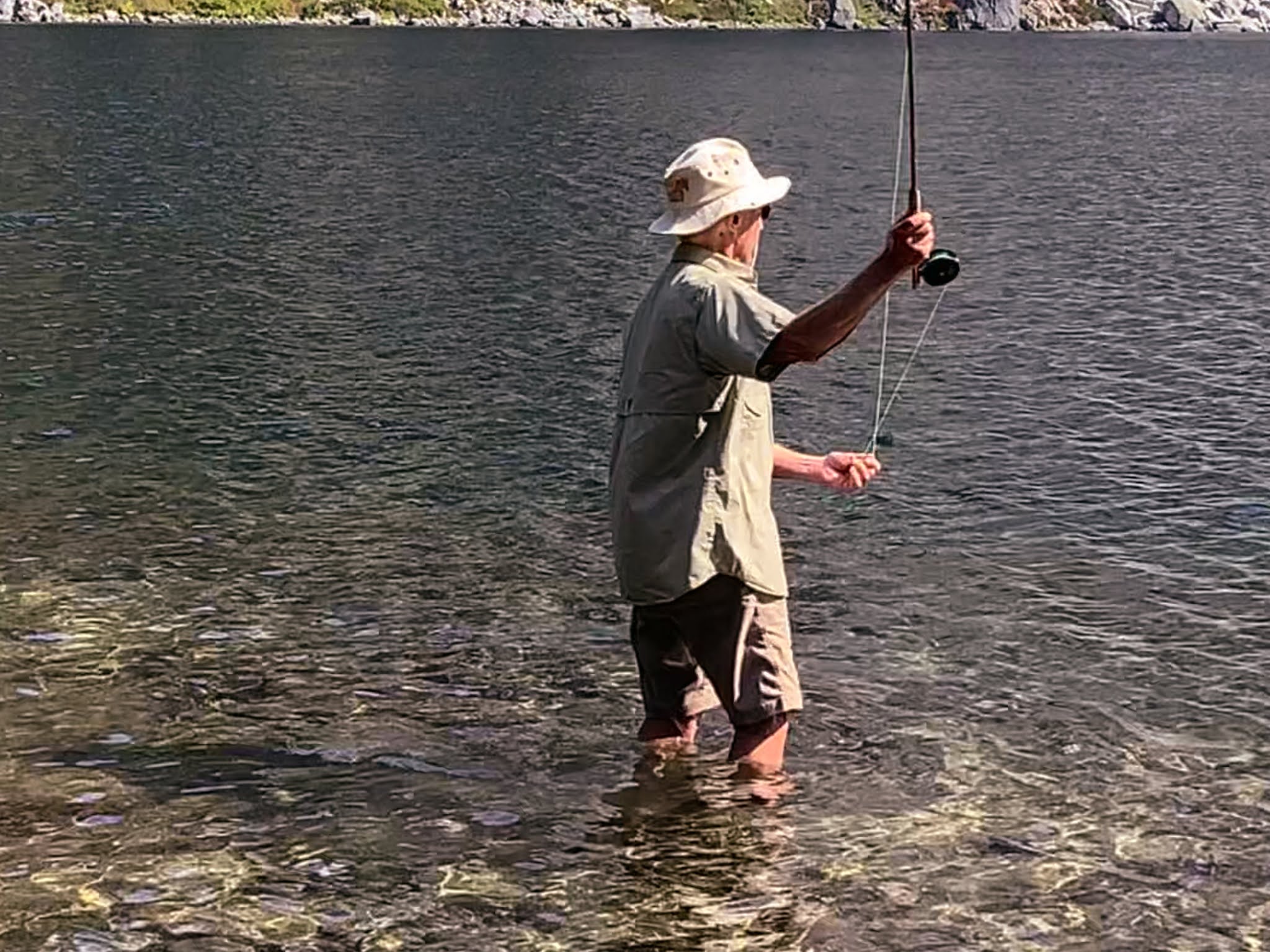
Up we went, over the Gap at 5,050' and down to the lake. A bite to eat, rig up, cast to rising trout.


My hiking partners were concerned; I was shaken. Sure, I’ve been aware of that malady called AGE. It’s been harder getting out of the shell now that we are back to crewing. I'm more wobbly; I don’t have the upper body strength of before; I tire in the stone yard after three hours, And I’m a bit whifty at times. I’ve always believed in willing my way through anything, but Tuesday’s drama has shown me that my limits are shrinking, coming down to meet a diminished me. 

How much faster and further to go? What will give out next? So far, I have been undeservedly blessed. Many of my classmates are gone. Some have lost beloved companions; others are struggling with progressive disease or cruel injury. I have so much to be grateful for.

Since Tuesday, though, sobering thoughts have haunted my days and nights. Will I have to give up our annual Sun Valley ski trip? Are things in order for Ann and family? Get going on cleaning out those office files and closets full of hobbies and junk! And -- no more cases of wine futures; start drinking your inventory.

I’m still willful: don’t get old; get older. The challenge is how to enjoy older, how to stay interested and interesting, to care. My only answer is to keep working Fletch Waller’s Three-part Mission Statement: 


Though still shaken, I’m thankful for Tuesday’s wake-up call on the Pacific Crest Trail. Come Sunday morning, what do I intend? What will I make of this 88th lap? How many strikes do I have left?


Sunday, August 1, 2021

The Best of '20

Since 2018, I have posted my likes among the photos I made during the previous year.  For 2020, the pickins' are slim; that was a year we stuck close to home, not rich in photo ops. So, few as they are, here are my 

Best of '20

The year seemed just to grind on --

Pulse, Tony Cragg, Mpls Inst. of Arts

In June we snuck away to a lake on San Juan Island. I watched an owl dive into the reeds, expecting her to come up with a duckling. No! Astonishing; she had a snake half again her height! She flew up into the fir right off our balcony where she sat gnawing on her lunch and eyeing me. The Athenians would have understood the good omen: their snake symbolized uncertainty, the boundary between one state and another, between life and death.  And here, Athena, goddess of wisdom in her manifestation of Owl, was defeating uncertain fate. It promised poorly for the virus, good for mankind (or, at least. for Athenians.)
  

Despite Covid, parents found ways to nurture their young.
Pa pileated and fledgling 

The sun rose each day, promising that we'd get through this -- 

-- especially if we stayed together.
September: day hike over Sourdough Gap into Rainier Nat'l Park