Wednesday, February 16, 2022

Me n' Olympics (as a teenager might say)


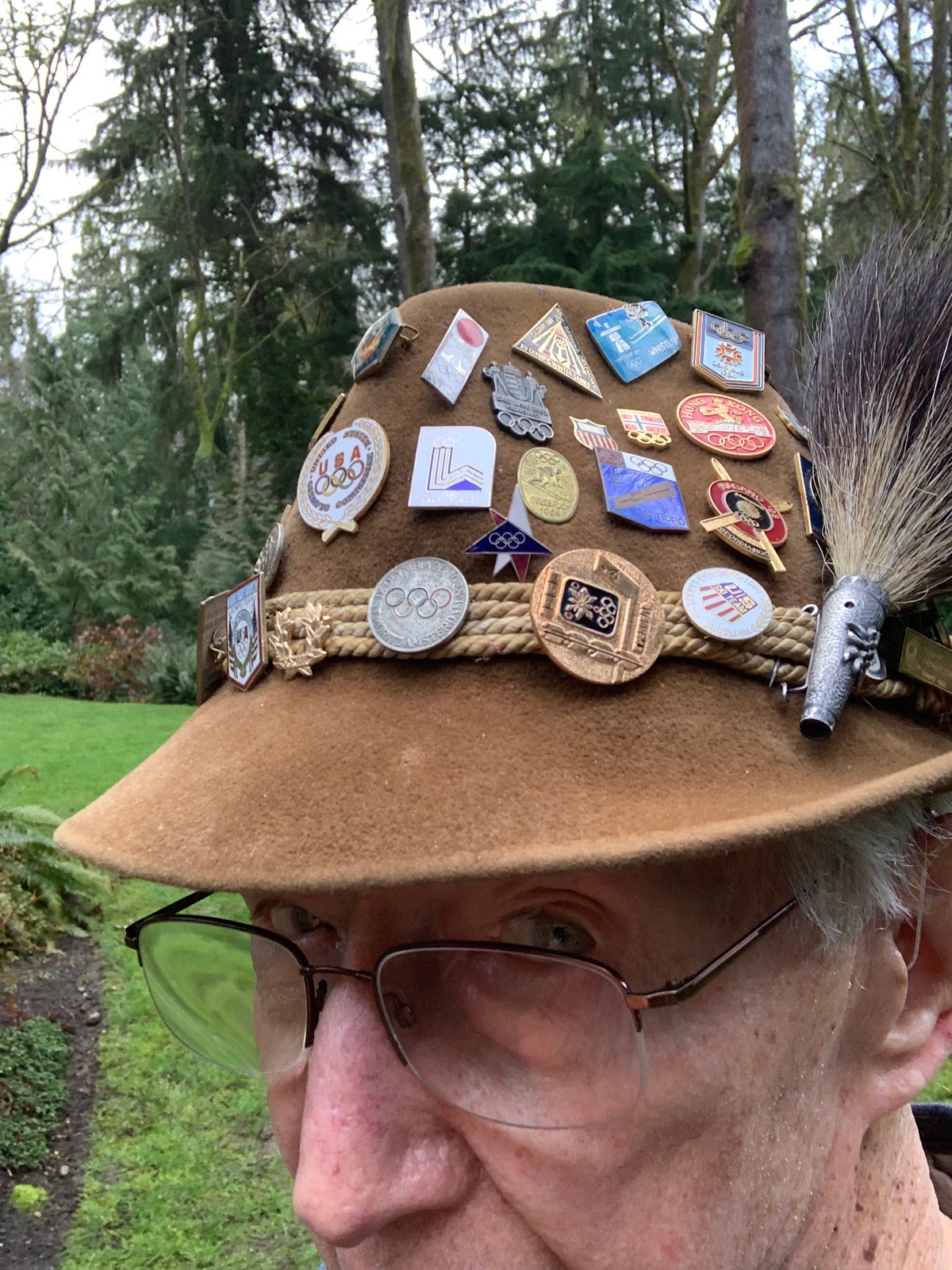
The pin hat weighs about
1.3 lbs. and currently
carries 76 pins  

Here we are, midway through the Beijing Winter Games. Olympic fascination for me has not waned. I watch mainly via CBC, for they let the sports speak for themselves more than does NBC, but USA has given me a third option. I still hear in my head the ABC theme song and “the agony of defeat.” I take down my winter Games pin hat from my office wall and think back to Games followed, the Games attended and the Games peripherally involved in.

The summer Games were the earlier interest; winter came later, after settling in Minnesota, even though in college I wore (out) an Olympic warm-up jacket from the ’32 Lake Placid bob sled team. Dad, then a Colgate Junior, had wangled his way with a buddy onto the back-up taxi-squad.

Early memories: I can harken back to the ’56 Melbourne Cold War romance of Czech discus gold medalist Olga Fikotova and American hammer throw gold medalist Hal Connolly. Also to the “blood in the water” gold medal polo match between Russia and a revenge-bent Hungarian team. They trounced Russia 4 – zip. Those summer Games were in December, i.e., summer down under, just a month after Russian tanks had rolled into Budapest. We didn’t have a TV in our little one-room Cambridge apartment but there was plenty to follow in the press.

I recall other bits and pieces – like Toni Sailor’s alpine sweep in ’56 at Cortina. Like that kid Cassius Clay in Rome, ’60. And Peggy Fleming winning the US’s only Grenoble gold in '68.  Later that summer, the ’68 student protest massacres in Mexico City, maybe worse than Tian’anmen, and Tommy Smith’s and John Carlos’ Black Power salute. The tragedy of Munich, ’72. 

I followed it all after TV was introduced at Cortina, but it wasn’t until ’76 that the Winter Olympic bug really bit.

Franz Klammer

I groused to the family before my annual European Toy Fair trek that I didn’t know what to do with myself during a four-day break between the Brighton and Nuremburg  expositions. “Dad!” shouted Frank, then a wanna-be free-style skier, “the ’76 winter Games will be on right there in Austria.” Sure enough: be a man of action, Dad. Our General Mills non-food group had just ventured into travel as an area of potential. I called our new partner and learned that they had an Olympic tour that would be in Innsbruck that weekend and gave me the name and suggested I contact on site their tour director. He might have some ins.

I stashed my business clothes in a Munich train station locker, put on Levis, boots, and an Eddie Bauer jacket (Eddie Bauer was then a part of the General Mills Apparel and Specialty Retailing Group) and hauled my duffle of ski boots and gear onto a train to Innsbruck. The “he” turned out to be a free-spirited PanAm cabin attendant moonlighting as a tour group director. There was no room at any inn, so he let me crash overnight in the back of the parked tour bus. The next night, I slept on the floor of a chalet filled with airline guys and gals. Party time: I was the quaint old fart, all of 41.

First day: PanAm’s tour flock were in the hands of a local mother hen, so he and I set out for Igls where the downhill and outdoor bobsled were run. To get to the downhill (no tickets) we climbed up toward the Patscherkofel, clambered into and out of the top of the bob sled run (can you imagine, today?) and hauled our asses on up to a curve on the downhill.  And what a curve! It was that infamous sharp right bend after going airborne.  We stood between a huge Swiss contingent clanging cow bells and an equally large mob of Italians swigging wine. The bottles and bells passed merrily from group to group accompanied with good natured, gratuitous insults. We were made honorary Italians and Swiss.


(Not mine: from Google)

And then came Austria’s Franz Klammer. Right in our face – arms flailing, legs akimbo, a crash in slow-motion. But he righted in air, somehow lined up for the next gate and delivered one of the most famous gold medal downhills to this day. 


The next day, I went again to Igls to watch the bob sledding.


Sunday, my tour guide buddy was off duty. We decided that we had to ski.  Off by bus to Kitzbuhel, rented skis and headed up the lift. Now, I was no way ready for Kitzbuhel, a marginal intermediate on my best days. My PanAm friend could ski.  Off he went, agreeing to meet up at end of day, 4:30 or so, at the ski rental. I blundered about up top, searching desperately for a green trail back down and being victimized by the Jah-Jah boys, those German-speakers so eager to be rid of you they answered jah-jah to whatever you asked, as “is this the trail back to town?” “Jah-jah.” Or “does this lead to a green run?” “Jah-jah.” Like hell! After countless falls, self-respect and self-confidence shredded, jeans soaked, I got to the bottom, that is, a bottom – a tiny town clear on the other side of the mountain, 25km from rendezvous at Kitzbuhel!

A local bus back around the mountain to Kitzbuhel, near 7 now; turned in skis to an angry rental clerk awaiting the day’s last pair; a drink at a bar full of handsome people in stylish skiwear glancing askance at this bedraggled bum with a 2-day stubble (not fashionable in 1976). After a bratwurst at the bar with a smug Italian skier asking if my mitts were ski or boxing gloves, I finally slunk off to catch the last train to Munich. About ten minutes to departure, I sitting like a Buddha atop a four foot tall steam radiator trying to dry out, in waltzes PanAm with a stunning English blonde on his arm. Back to the real world: in Munich, recovered business gear, got a room at a rail station hotel, a hot shower and a morning train to Nuremburg. My Olympic adventures ended. 

Well, no.  --  Little did I suspect, but my Olympic adventures were just beginning.


Montreal, ’76 and Bruce (or Caitlin as you will)

When I got home, telling the tales, I realized that I wanted the family to experience the wonder, the nationalistic joy, the thrill of the Games, the delight of the crowds. The ’76 Summer Games were to be in Montreal just four months off; at this late hour, could we get tickets, could we find a place to stay? Had to pay scalper prices but got tix for two days of track and field, diving and swimming prelims, soccer and volleyball. For advice on lodging, I called the VP Sales of our Canadian Parker Brothers subsidiary, based in Montreal. Wonder of Wonders: he and his family were abandoning the city for the duration of the Games and going to their lake cabin on north. No, they weren’t renting: "strangers, you know. Would you like to use the house?" Would we?! We drove to international Falls, caught the overnight train and we were part of the Summer Games!


Montreal had gone full out, with construction corruption feeding the development frenzy. It took 30 years to retire the debt the city took on to build their facilities -- but what facilities!

1976 – America had a long tradition of decathlon champions: Bob Mathias, Rafer Johnson, Milt Campbell, Bill Toomey. But in ’72, at Munich, one of those horrid Russians had taken the gold away. America embraced its fresh, great hope, Bruce Jenner, along with his loyal, enabling, beautiful wife Chrystie. And the Wallers became Jenner groupies. 

At end of first day, Jenner was 35 points off the lead. Steve decided we needed to do something to show our love. That evening, we bought shelf paper and spray paint and made a banner in the back yard. 

The next day, Jenner came through. A huge American flag was rolled out over our heads, so Frank, Steve and Amy raced up the aisle to above the flag where their puny banner could be seen. Seen, first on CBC that night back at the house, much to their delight. Then, again, the next week in Sports Illustrated's lead photo of its spread on Jenner.

CBC


Sports Illustrated

But that isn’t the end of the story. Soon after our return to Minneapolis, I left the Craft, Game &Toy Division to take the reins of Marketing Services, a gaggle of departments that executed and supported the marketing programs of the food brands and those newly acquired non-food companies, departments such as marketing research, advertising, packaging, media operations, publicity, Betty Crocker kitchens and cookbooks, nutrition, etc., etc. 


Among new packaging projects in the works was designing the latest Wheaties iteration, its new Breakfast of Champions featuring, of course, America’s Decathlon darling, Bruce Jenner. Bruce came out for the Cereal Division’s unveiling of the new Wheaties Champ. So I arranged for Bruce to come by, meet the kids and Barbara, and autograph the banner of which he, too, had a photograph. I thought my wife and secretary would swoon like a couple of teenagers; indeed, Barbara later said her palms had been sweating at meeting him. 

Honestly; what would Caitlin think?


Moscow

The ’80 summer Games were slated for Moscow. In January of ’77, I got a call from the President of Bowers and Ruddy, the numismatic company whose acquisition I had engineered for the hobby group within my old Toy Division. David Bowers told me he had received an invitation, virtually a summons, to appear just 12 days hence at HQ of the Veneshtorgbanc, the Soviet Bank of Foreign Commerce, in Moscow, to be interviewed and negotiate for the rights to market Russian Commemorative Olympic coins in North America. I have written elsewhere in these Ruminations (Jan., 2021) about that bizarre experience. 

Three of us made the trip. We decided after the first day’s meeting to decline, but crafted overnight what we thought a program should be. The next day we gave our best but unwelcome advice to the young, increasingly distraught project manager and his boss -- a boss who seemed to take great satisfaction in the discomfiture of his young associate. The culmination was when I cited data from Ottawa’s newly-released report on the success of the Montreal Games’ commemorative coin program. I pulled the report from my briefcase and asked had they seen it. “Yes, Yes” (at least not jah-jah) was his hasty response. I offered to leave the report with him. No, no, no need. At that moment, the third occupant of the office, a man introduced as having no English and who had sat silently in the corner , wheeled his chair into the middle of the circle, extended his hand, and said “I’d like to have that report, please.” I’m afraid at that moment our young friend’s goose was cooked.   

We came away with a commemorative coin, a Soviet Olympic lapel pin, a feeling that we had tried our best to help them, and fabulous memories of snowy days in Brezhnev’s Red Square. 

The two Daves: Kelby (l), our lawyer, 
and Bowers (r), the numismatist

Russian tanks rolled into Kabul in December of ’79. President Carter cancelled US participation in the Games. The commemorative Olympic coins were never directly sold in the US.


LA

Lake Placid came and went leaving a warm glow for us Minnesotans with its Miracle on Ice, the US hockey upset of Russia and gold medal win over the Czechs. By ’84, I had moved on to Marriott.

Marriott is, of course, one of American Express’s largest source of card charges. And American Express was among the primary sponsors of Olympics.  And so, a delegation of us were wined and dined by AmEx at the LA Summer Games. We were insulated from the giddy crowds; we were escorted VIPs. Our escort: George Plimpton. 

We didn't mingle 
with those folks


Santa Anita
We didn’t choose our events, all was pre-scheduled by AmEx. And each had its own host to lecture and explain the who, hows, and history. Our event host at the equestrian jumping competition, at Santa Anita, was Capt. Mark Philips, gold medal equestrian at the ’72 Games and husband of HRH Princess Anne, competitor for Britain in the ’76 Games. 


Nothing was left to chance. All in a protective, bubble. Barb and I did go AWOL to visit the LA Museum’s special show of Impressionist landscapes. And we came away with Olympic pins galore.


Calgary, ‘88

At Marriott, I regularly had been part of rather extravagant entertainment of major customers. When I came to Westin, I was told by my sales VP ‘No, we don’t do that; the chairman does not discriminate among customers and does not want to make small customers feel bad.’ What!?

The ’88 Games were to be held in Calgary; the relatively new Westin to be ABC’s HQ hotel. How many rooms could I get? The hotel reluctantly gave up 14 rooms for four nights each of the two weeks, i.e., 112 roominghts which otherwise could have been sold at premium rates. OK, I asked the Sales VP, “what percentage of our group business is done by our top 20 customers?” Just shy of 77% was the answer. OK.

I presented the plan and a full-bore budget at the next Exec Committee meeting. I could see the other Exec VP’s thinking, Oh, boy, here’s the new guy with an extravagant wish; watch Harry shoot him down. I explained twenty major customers, ten each week for four nights stays, the 77%, receptions and banquets, ABC television HQ, and – Harry, as Chairman, you and Mrs. Mullikin, will host the first week which includes the opening ceremony. Dwight, as President (to whom I nominally reported), you will host the second group the second week, which will include the closing ceremony.

Well, opined Harry, well. Hmm. Opening ceremony? Well. Well, it’s an excellent way to publicize our new hotel. And to thank these important customers for their loyalty. I think we ought to take full advantage of this wonderful opportunity.

And so it came to be. We applied lessons learned from AmEx – not to overly host, to mix events of choice with pre-planned options of outings, to encourage and give ample opportunity to mingle with crowds, to allow folks to dine on their own, and so on. We added some new wrinkles, like Roffe custom-designed, sized to the guest, matching ski gear – boots, pants, sweater, jacket, hat and gloves – laid out on the beds of our guest couples upon check-in. All in all, an immense success! And heroes like British ski jumper Eddie the Eagle and Katerina Witt defending her '84 Sarajevo gold made it all the more so. 

The Marvelously Ridiculous . . . 

, , , and the Sublime
(from Google)

Sitting in the stands at the ski jumping,  two people came up and wanted to add  a pin to my hat, and there they reside  today. 

I was so busy hosting and tour directing, that I took no pictures. Thanks to Google for these.


Pin collecting really took off at Calgary. We gave each of our guests a starter set and encouraged them to trade away. I recall one of our customers, a big, gruff guy, spotting my pin hat, yelled out that this pin stuff is just stupid, who cares? Then he burst out laughing, whipped open his ski jacket to reveal inside both flaps and his sweater lined with tens and tens of Olympic pins he’d been trading.

Vancouver and Whistler, 2010

Albertville and Nagano were just too remote, and for some reason I passed on Salt Lake. But when the Games came to Canada again, and to Vancouver, our neighbor just up the road, I couldn’t resist, especially when Frank Novosel, a buddy of mine and a winter sports nut, suggested we go and live out of his RV. Back to no plans, no tickets, no corporate VIP stuff, just going and being there.

Neighbors to the North
Befriend Frank
It was wonderful. Canadians really are nice, you know, as I’ve written elsewhere in these Ruminations.

We had a ball. Frank is a downhiller. I haven’t downhilled since 1990, have been a skate-skier since, and as I said, I was mediocre downhiller on my best day. But I figured it would come back, like riding a bicycle, so I rented skis and we lifted up to the top of the downhill intending to ski down alongside the races. Well, “it” didn’t come back. I demonstrated total ineptitude, worse than at Kitzbuhel, much to my chagrin and Frank’s amusement. 

Doofus on Skis
It must be that 1988 Roffe 
outfit that makes
me 
look so stiff


Once was enough; the next couple of days, I went off to the cross-country races at Blackcomb while Frank stayed on the mountain. We parked the RV at the Vancouver Yacht Club where we had access to showers and their TV room. We watched hockey (tix unavailable that week) and skating, went to mingle at the awards center, watched Lindsey Vonn find her just, golden reward.


Lindsey Returns


Whistler is small and relaxed. One could wander the streets and chat up competitors like German twice gold medalist Maria Riesch out taking a stroll, for the most part in welcome anonymity. It was all that the Olympics hope to be – those uninhibited, rare, a-political moments of shared joy. 


Maria Riesch out for a stroll

2026?

The Winter Games will return to Cortina. That would be on my 92nd lap around the sun. In fall of 2018, Ann and I ended in Cortina our week of hiking through the Dolomites with Gary Scott; I'd love to see it again.


Monday, January 17, 2022

I Don't Make New Year's Resolutions. I Set Goals


My Biggest Management Challenge.

Perhaps you’re expecting an anecdote or story – from Marriott or Westin or General Mills or wherever --  but mine is a continuous management challenge, one always with me wherever I go. For it is I.

I am my biggest management challenge  – how to manage to achieve the goal of happiness and contentment, of comfort with what and who a Fletch Waller is. So how do I tackle that?

Mission

I start with a mission statement. I thank Scott Okie for turning me onto the benefit of -- in my case, need for -- a personal mission statement. My first, in that angst-ridden year of my retirement, 2005-06, read:


To enrich Ann’s and my shared lives,

and

to invest my time, energy and experience in helping not-for-profit

organizations become more effective and productive.


I pursued that mission to great happiness with Ann and fifteen fascinating years of work for the likes of Horizon House, Seattle Repertory Jazz Orchestra, Pratt Fine Arts Center, and Seattle Chamber Music Society Foundation. Now that I have retired again, having left behind officer roles, directorships, and trusteeships , it’s time for a new mission statement to be posted above my desk:


To continuously enrich Ann’s and my shared lives,

and

to steadily improve each of my six spheres of being.


Spheres of Being?

Lots of sources imagine one’s existence as a nested set of spheres or concentric circles. I poached from them to portray mine as six spheres:

1.     I: the id and ego of me

2.     Spouse: my shared life with Ann – wife, lover, friend, chum, partner, companion, coach & critic

3.     The Clan: the extended family, blood relations, step-relations, in-laws

4.     The Tribe: team members, associates, friends, acquaintances, those linked by common interests and common experiences, and their clans

5.     The World: the unknown “others” whose welfare and behavior affect the milieu within which the first three operate; life in all its forms; the planet we share, Gaia’s realm.

6.     The Spirit: the mystical why of all this


So, how can I set out to “steadily improve” each of these?


Goals, not resolutions

I eschew New Year’s Resolutions. I set goals. At the beginning of each year, I reflect on and set written goals in each of the six spheres. Some of the goals are big deals, some little. (I’ll get to priority-setting in a moment.) For example:

In #1, Me, among my several goals for this year are:

row at minimum 2x/week and exercise or yoga on off days

finish sculpting The Yin and Yang of Yearning and begin Toby

publish 15 or more posts on Northwest Ruinations

read > 18 books

and so on . . ..


You will note the dimensionality, the quantification or definition. I believe in measurement; if it can be measured, it’s real. Not every goal is so quantifiable, but I strive to be specific. More examples:

#2, Spouse:

spend most of April in Puglia and Sicily

have a monthly date-day (lunch, movie, museum, attraction, whatever.)

digitize all slides

and others.

#3, Clan:

Visit Amy in Costa Rica

Support Christopher’s tuition

o   etc.


Even in more abstract and distant spheres, e.g.:

#6, World:

Sustain memberships in Nature Conservancy, WWF, NWF

Sustain support for IRC and Amnesty Int’l

Attend >4 World Affairs Council events

and so on


In all, among the six spheres, 28 goals for 2022.


But day-to-day?

Well and good on an annual scale, but how do I manage myself day to day, week to week? First, I must counter my urge to procrastinate, one of few skills I have truly mastered. As I am a morning person, a few mornings a week I make a list; the list disciplines my days. This sort of behavior tags me as “anal” I suppose, but that’s not the half of it: I fess up to the satisfaction of adding to the list some unplanned thing just done and then, with guilty pleasure, crossing it off. Haven’t you done that?


Once listed, I can establish priorities between current items. I rate each on both Immediacy and Importance, awarding a 1 to 3 score. Some unimportant things must be done right away; some important things can't be tackled right away. The higher the total for each item, the higher its priority. (Yes, I know: anal.)

 ~~~~~~~

Friends occasionally comment on how active I am, with how many things I am involved. I don’t think of myself as such; I know many others who accomplish much more. But if I did not use these simple tools to address my most challenging management case, what a mess of fruitless-ness Fletch would present to the world. My first-sphere ego wouldn’t stand for that.


I'm not prescribing: each to his own. Ann just read this and commented that most people would not put up with somebody like me.  But she loves me – she says – and I believe her -- always.    

Tuesday, January 11, 2022

The Best of '21: Not Great Art but Great Memories


Click on pics to open in larger view


Alone on Rainier, Spring


Welcometo Arches

Couldn't resist: Bordello Museum, 
Bawdyville, Idaho

(Blue) Tetons

Yellowstone Lake


Cohab Canyon, near Fruita, Utah

Kolob Canyon Better than Zion for 
old farts)


Kolob Canyon - end of the line


San Juan Island

Swamp Canyon, of Bryce

Willis Creek, Grand Escalante Staircase.
Enter ye who dare

Yakima Canyon, early spring


Zion shade

Willis Creek slot canyons

Babylon or Arches?


Balance . . . balance!

Arches' double Arches

Bouchard Gardens, Sept.


Lake Valhalla, off Pacific Crest Trail

For me? Oh, you shouldn't have. 
Victoria, BC

Friday, January 7, 2022

The Magic of Music

Friday the 7th, on Mercer Island: I was supposed to be on the road with Ann heading for Mazama, in The Methow, for a five-day warmup for next month’s skiing in Sun Valley. But no, here we are stuck (thank goodness we are blessed with a warm, secure and comfortable home unlike those poor souls out there in tents), unpacking luggage for things to wear and the portable fridge for breakfast fare, trapped in this Puget Sound basin by huge snowfalls in the passes, land-slides north and south, flooding of the rivers flowing through to the Sound and the relentless, torrential rain. All is shut down; nothing to do but ruminate.

The Magic of Music

Yesterday, my friend Bill R gave to our luncheon speakers’ club a charming talk entitled “The Magic of Music”, a back-in-the-day tale of the Claremont College choir of which he must have been a stand-out member (Bill then a full 6’8”.) The choir had been invited to repeat its Mozart’s Requiem at Saint Andrew’s Abbey, a monastic retreat in the Mojave Desert. The choir sang in the rustic outdoor chapel to the Sunday mass congregants, mainly migrant farm workers from nearby camps and fields, people rarely if ever exposed to full choirs and such music. They sat in stunned wonder, then burst forth their tearful joy and gratitude, often only in Spanish, but clearly communicating to these supposedly worldly, somewhat cynical college kids what their gift had given. In turn, Bill and his mates were awed by the response. The magic of music left lasting impressions on both choir and audience.

 Music has brought magic to Ann’s and my shared lives.

Last night we went to Benaroya Hall to hear the Seattle Symphony do a program of John Adams’ music, conducted by Adams, himself. I knew little of Adams, thinking of him mainly as a minimalist. He long since left minimalism behind, now composing elaborate, challenging, technically demanding works inspired by current contemporary events and themes, e.g., his opera Nixon in China. The first piece last night was a musical interpretation of his hair-raising ride in a 1950’s Ferrari; the third, a full symphony inspired by the sound tracks of film noir and the driving be-bop of Coltrane, Parker, and Johnson.  

The second was our favorite because of its form, a piano concerto, and its soloist, Jeremy Denk. Jeremy we’ve met a few times when he used to appear in the Seattle Chamber Music Society’s Summer Festival. Some years back, Ann and I dining at a New York restaurant, encountered Jeremy who not only recognized us but also dredged up our names from his memory bank.  Oh, to be young and a genius; names never to be misplaced on the end of one’s tongue!

To be married to Ann is to be bathed in music.

How do you get to Carnegie Hall?

During spring and summer, music spills out into the street from our open windows and doors. It is her constant companion (and because of hearing loss, a high decibel companion for sure) – symphony, chamber, opera, interspersed occasionally with my jazz. In the evenings: piano practice. I love to hear home music practice for it says to me “a happy home.”

I spared you the video of
Piper at full howl.


It’s not just our home. For our 13-yr old grandson, Max, music is all-consuming: trumpet, keyboard, guitar, drumming, and composition. When the family visits, it takes only minutes before Max is improvising on the piano. At home, his accompanist is Piper.

Max got that Harmon
mute Jay Thomas 
recommended


Ann was my tolerant companion to Seattle Repertory Jazz Orchestra concerts. Now I have an enthusiastic companion to whom I’ve introduced saxophonist and artistic director Mike Brockman, pianist Randy Halberstadt, trumpeter Jay Thomas, and others of its stars. Max plays in the Middle School jazz and marching bands under Music Director and SRJO trombonist David Bentley and his staff. 


Tonya and Parker: aspiring
pianists, also.

Ballet and Bernstein

Over the holidays, Max went, out of loyalty to sister Molly’s dancing, to two Nutcrackers; for Grandpa, one is enough.  On Christmas afternoon, Max’s uncle Grant took Tonya and cousin Parker to view Spielberg’s revival of West Side Story. That, in turn, reminded Ann and me of Bernstein’s recording session with glorious Kiri Te Kanawa and Tatiana Troyanos and poor, badgered Jose Carreras. We YouTube’d the video and have spent the last week humming, singing, and whistling those magic Bernstein songs.


Music’s magic has brought me great joy.

My first date with Ann was a Summer Festival concert after her picnic-basket-dinner and my wine on the lawn of Lakeside. And who could have predicted that having been, on a lark, a supernumerary in the Met’s annual tour appearances in Minneapolis, that I would really become an opera fan under Ann’s tutelage? Or that violinist, conductor, and PBS star of Now Hear This, Scott Yoo, would become a close and dear friend of ours? The Magic of Music, indeed. 

Monday, December 20, 2021

The Coad Table Idealist and Realist Agree: Time for a Change of Direction

Earlier this week ten friends gathered for the first time after nearly two years of Zooming, to renew and re-launch an in-person Coad Table. 

The Coad Table . . . 
. . . meets every six weeks to discuss our response to and responsibilities in international affairs. The group is named in honor of Tom Coad who with Don McLaren founded the group years ago as a monthly, over-dinner discussion. Both Don and Tom were past-Presidents of the World Affairs Council; Tom’s particular interests were over-population and nuclear hegemony. Don’s, the forging of collaborative efforts to address conflict. Both, sadly, are gone but their legacy of concerns is carried on by fifteen or so of us old white guys. (Care to join? Give me a call. The younger and more colorful, the better.) 

Climate Change 
Last Tuesday, our impossibly broad subject was climate change and global warming. Eight of us catalogued the obstacles to meeting the +4°F Paris and Glasgow goal, but implicitly accepted that our course was to proceed and overcome those obstacles, as difficult and unlikely as that might be. Two of us, I in this camp, demurred: the war on global warming has been lost; it’s time for a change in direction. 

The Global Warming War Has Been Lost 
At risk of being called defeatist and isolationist, both of which labels I reject, let me argue my view. First, we already have used up half of the +4° leeway set in Paris at COP 21 (the United Nations Climate Change Conference, 2015) and re-affirmed at last month at Glasgow. We are more than +1°C (1.6° F) above pre-industrial 1890 temperature on average, and some areas of the world ahead of that. A neat way to see what’s happening around the world is to open and peruse these quick, “post card” bites of information on climate experiences in each UN member nation 

Second, the developed nations’ 2015 pledges of financial support for lesser developed nations have not yet been paid. The need for and costs of investment escalate as global warming proceeds. We aren’t about to catch up. 

Third, the developed world does not exhibit the will needed to dramatically move to zero emissions. Mandates are eschewed; carbon tax proposals are shelved. One of our Coad Table guys observed that there are three parts to the puzzle: the natural, long cycles of earth’s evolution; our man-made environment and technological change; and the social compact to act together. We can’t control the first. We may have some better tools coming on stream, such as batteries for storing wind and solar power, new methods for re-cycling water and minimizing fresh water usage, etc. Bill Gates, writing in his latest Gates Notes blog, holds out hope for technological silver bullets, mainly in energy generation, that will get us to net-zero by 2050. 

But the roadblock is that social element: the will to undertake drastic, bold action. There is no prospect for marshalling such will world-wide, nor among the top five polluting economies – the US, China, India, EU, and Russia. We will be +4°F long before 2050. The war on global warming has already been lost. There is going to be more destruction, increasing dislocation, growing distress. The US strategy must now change and focus on our own welfare. This doesn’t mean abandoning the world but first making sure that as few as possible of our own become climate war victims. 

A Change of Direction 
Last week, I attended a World Affairs Council panel discussion on what local companies were doing on climate change. On the panel were the top climate change officers (with various titles) of Boeing, Amazon, Microsoft, and Alaska Airlines. The four talked about re-cycling; cutting use of plastics; using renewable sources of energy; developing “sustainable aviation fuel” (whatever that is); converting to electric vehicle fleets; constructing green buildings; and so on – all good things in pursuit of forestalling global warming. 

When question time came, I asked “if your CEO or board directed you to focus on anticipating, avoiding, and mitigating damage from climate change, how would that change what you do? It was four deer caught in the headlights – motionless, staring, silent. Finally, Amazon’s Chris Davis, Sr. Mgr., Sustainability Policy, said something like this: we’d have to start with and really step-up risk assessment. Mind: this was two days before the tornados in Tennessee and Kentucky, one of which flattened an Amazon distribution center, killing six employees. 

What dangers? 
Prepping for the Coad Table discussion, I listed for myself nine categories of climate damages and dangers to the US, and some steps that might be taken. Were we to try nothing, chaos, destruction and distress are guaranteed. Here is my list, in no particular order, which means Davis, of Amazon, nailed it: risk assessment is key to sorting out goals and priorities: 
• Water -- Ocean level 
    Develop and install estuary gates a la Netherlands and Venice 
    Protection and renovation of locks, docks, cargo piers 
    Levees to be raised and, in some cases, removed to restore wetlands as storm water diversion 
    Zoning and insurance
        No re-building on barrier islands and coastal plains – as homes destroyed, no replacement 
        State insurance commissioners use punitive rates to re-locate populations 
        Subsidized re-location programs 
• Water – storm surge 
    Increase capacity of storm drain systems 
    Protection of industrial plants – especially nuclear and other power plants 
    Protection of city infrastructure 
        Levee subway accesses 
• Drought 
    Watershed process for resolving allocation issues 
    Desalinization plant investment 
• Wildfires 
    Zoning in unincorporated areas
    Increasing manpower and capacity of forest fire fighting orgs 
    Fireproofing electrical grids 
• Fertility zone changes 
    Beef up USDA county Ag Agents 
    Increase funded crop research 
• Frequent and severe storms: tornados, hurricanes, thunderstorms 
    Power and Grid vulnerability 
    Industrial Plant vulnerability 
    Catalog high potential damage zones 
• Migration 
    Guest worker program 
    Climate refugee rights accord 
    Interdiction of illegal immigration 
• Domestic terrorism and cultural conflict 
• Species extinction and diversity 
    Weight in risk assessment? 
    Protection of ranges in face of migration and new fertility zone pressures  

A New Direction 
Such enormous projects of risk assessment, damage avoidance, mitigation and emergency response require a national consensus and extraordinary leadership to forge it. Some of Coad Table group cautioned that autocracy and armed forces enforcement might be called for. But autocracy is not required if a consensus on the threat to the commonweal and a clearly defined purpose can be articulated and a compelling call to patriotism be made. This doesn’t mean stopping research into clean energy and carbon footprint reduction; it does mean setting new priorities and undertaking new investments and expenditures at local, state and federal levels. 

How will all this be paid for? First, weight priorities for the new infrastructure authorization toward projects that have climate damage mitigation effects.  Next: how about forgoing the ten-year, $3 trillion ICBM modernization program, decommissioning that third and increasingly obsolete leg of the triad, and relying on submarine-launched nukes and air-launched cruise missiles and strategic bombing as our deterrents? Freeing up $300 billion a year will go far to paying the bill for a comprehensive climate damage strategy. Reducing the risk of unintentional nuclear exchange would be a welcome dividend. 

Does this mean turning inward and isolationist? Not necessarily. How about curtailing all military assistance programs and replacing them dollar for dollar with climate disaster preparation assistance? That would buy a far larger and more valuable impact. How about closing the War College and creating a Climate Adaptation College for both domestic and foreign designees? 

The Third Label . . . 
. . . I will be tagged with is alarmist. Yes; the alarm bells need to be rung. I am alarmed. Now a third of the way round my 88th orbit of the Sun, I likely won’t be here to see what happens, but your and my children will be. Our grandchildren are potential victims. And my great-grandchildren? 

And the Fourth Label? Idealist 
OK, guilty. My friend Bill R recently said “when you are confronted with an idealist, run for your life!” But we have no place to run to. All I’ve suggested here is feasible even though unlikely. 

Bill is a realist. But Bill and Fletch, the realist and the alarmed idealist, were the two Coad Table outliers who said climate change is here; the war to forestall global warming is already lost; it’s time for a change of priority. And that change is to ring the alarm and engage Americans in a crusade to mitigate the damage that global warming is already beginning to wreak upon us. 

PS If you find this provocative, pass it along to an acquaintance, preferably one of those Gen Z’ers who will inherit this mess we’ve been making. They are the promising ones of passion and idealism.

Sunday, November 21, 2021

Connections Enmesh

Life and art and death and ceremony – over the last three weeks, separate threads have woven about me a web of connections, a net not unlike that in which Moby Dick ensnared Fedallah, the shaman. Moby Dick?! Yes, Moby Dick.

The G.A.N?

All began when I read a NYT review of Albert and The Whale in which Philip Hoare explores fabulous animals in renaissance art, the genius of Durer, the mystery of the whale. Hoare, a British polymath, follows rabbit trails into art history, German literature, cetology (look it up) and more, but merges them back again and again into his mainline of thought.  Thoroughly engaged, I next ordered up from the library his earlier book, The Whale – all one would want to learn about whaling. The skeleton of that book is Moby Dick, so that led to diving again into 600 pages of Melville.

This all at a time when daughter, Amy, and favorite son-in-law, Jeff Stoner were laying plans for their first salt-water foray into our Salish Sea’s San Juan Islands. Amy’s desire was to see southern resident killer whales. They twice encountered a pod of orcas, a good omen. Their visit culminated in a wonderful birthday dinner prepared by them and shipmates/dear Mpls friends, Colleen and Jordan, who happen to be trained chef and restauranteur.

Two Fridays ago, I finished Moby Dick (my third reading, the last some 35 or so years ago) and prodded by Hoare to look more deeply, worked at doing so. The next morning (connection?) the New York Review of Books reviewed an exhaustive biography of Melville, adding to my new-found esteem for this witty, informative, sensual, intriguing morality tale of life and death, good and evil.  Like most great works of art, Melville broke conventions and conceived a new form of the American novel. Last Thursday, in conversation with a young fellow-Hamilton Chi Psi, he brought up founder Philip Spencer, the inspiration for Melville’s Billy Budd. Connections.

Yang taking shape
Last Sunday, following a stint in the stone yard where I’m nearing completion of Yang of The Yin and Yang of Yearning, Ann and I attended another’s birthday party, a celebration of the 90th of novelist Mary Morgan, our dear friend.  She was widowed two years ago, but carries on – spry, vibrant, witty and with it.  One-by-one, she introduced 40 guests from around the world, relating to us how and why each was important to her. She’s a model (though no longer writing; try The Sound of Her Name – a good read; St. Martin’s Press, ’05.)  
A tale of the long reach of war


Then, last Thursday, came the ultimate ceremony: the funeral mass and internment of friend and fellow Olympic Clubman, 77-year old Dennis Ortblad who died of COVID despite being fully vax’d, alone in an induced coma, on a ventilator, in a Moscow hospital ten time zones and 5,000 miles from loving Mari and family and friends. That austere Catholic message: he’s gone; you will see him again in Heaven.

We sobered clubmen met after the internment; a speaker explored Biocentrism, the theory that there is neither life nor death nor a single, separate existence, but a continuous flow of perceived time and space and energy, of perceptual co-existences in multi-verses. Mysteries . . .

. . . Dennis’ coffin laid in Mt. Pleasant Cemetery

. . . Ishmael in beloved Queequeg’s coffin, floating on the South Pacific

. . . Fletch in his web of connections, immersed in his Sea of Rumination.

Dennis Ortblad, Citizen Diplomat