Saturday, March 24, 2018

Today, I Marched for Their Lives: Natalie, Molly, Parker, Max, Ella, Christopher, Liza and a Million Others


From Cal Anderson Park to the Seattle Center --


Mine was an M-1; His was an M-16

Orange is the color of ban


Yes, she really feels this way.  

Friday, February 23, 2018

Toward a New Second Amendment


No other part of our sacred Bill of Rights creates as much discord as does the Second Amendment.  We all know what the Second Amendment is, but let me repeat it here for your examination:
               “A well regulated Militia, being necessary to the security of a free State, the right of the people to keep and bear Arms, shall not be infringed.”

Original Intenters know that in 1787, at the time Madison drafted the “Bill of Rights”, there was widespread distrust of and a universal desire to be free of standing armies, which the British had used to dominate and subjugate the Colonies.  The Founding Fathers could not come to consensus and avoided the question.  Hamilton, writing as Publius in Federalist Paper #24, thought it nuts that the Constitution addressed neither the need for nor the prohibition of a national defense force.

After many state delegations had voiced concern that individual rights were omitted from the Constitution, and that amendments were called for, Madison drew on Virginia’s Declaration of Rights, one of which addressed "the proper, natural, and safe defence (sic) of a free state" and said that it rested in a well-regulated militia composed of the body of the people, trained to arms, and that standing armies, in time of peace, should be avoided as dangerous to liberty.  There were dangers lurking out there, especially on the western and southern borders – British raiders from Ontario and French from Quebec, Spanish from Florida, hostile Indian tribes and nations – and in order to assure a responsive militia some armed citizens needed to be on call.  Keeping and bearing arms was a necessary right for the security of the community.  The original intent was clear: to assure and maintain a well-regulated militia. 

Just four years later, in Washington’s first term, it had become clear to him and to Congress that a standing army was desirable. The “Legion of the United States”, a nod to sensitivity about “Army”, was formed.  Later that same year, that silly name was changed to "the United States Army."  The need for having armed citizens on call began to be diminished and has steadily ever since.

Literalist interpreters of the Constitution set aside that conditional first phrase – “A well regulated militia being necessary to the security of a free State” and those pesky 18th C commas – and focused only on the words “the right of the people to keep and bear arms shall not be infringed.”  The Literalists are the ones that got us here.

Times have changed since 1787 and 1791 – Duh.  Then, the cost of a musket or rifle was about the annual income or surplus of a typical farmer or settler; today it’s a mere fraction of one’s income.  The Economist estimated that in 1850, only 10% of adults owned firearms.  Today, despite urbanization which depresses gun ownership, it’s 30% in total and 44% in rural areas.  300 plus million guns are out there circulating among we 250 million adults.  And controversy over regulation, prohibition, military style arms, sale and transfer of ownership just becomes more heated, more ideological, more intolerant and uncompromising.

Can’t this Gordian knot be cut?  Is it not time for a new Second Amendment? 

Principles? 
  1. Citizen control: what works for Washington, DC may be overly restrictive for Wisconsin; what works for Montana may not work for Seattle.  
  2. Realism: like it or not (and I do not), arms are part of our history and culture; common-sense regulation should be our end, not prohibition.


 So, try this on for size:
Well-regulated civil and military services are necessary to the security of United States Citizens.  Each individual State’s right to regulate its civilian citizens’ acquisition, use, and sale of firearms shall not be infringed.

Is this palatable?  To the NRA and its arms dealers from whom most of its funding flows?  No.  To state’s rights conservatives? Yes.  To Liberals?  Yes.  To urbanites and rural dwellers, to hunters and sportsmen?  Probably.  To criminals?  No, with a shrug, given 300 million firearms accessible one way or another.  But is this pragmatic approach feasible and sensible?  Perhaps so.

If you like this approach to a new Second Amendment, copy this and share it about on Facebook, Twitter, and with your legislators, both State and Federal.  If you can improve it, do so!  Let’s opt for common sense and find a better answer than endlessly arguing over how to apply an 18th C concept to our 21st C reality.

Tuesday, January 23, 2018

A Tale of Two Clocks — and of a Happy Gamble.


In 1806, Deacon Joe Waller ordered from Riley Whiting, a Winchester, Connecticut clock maker, the wooden works, pendulum, and weights for a long-case clock, a ‘grandfather’ clock.  He had made, or made himself, we don’t know which, a beautiful but rustic case of walnut, and thus was created “The Waller Clock” for his new farm in West Enosburgh, Vermont.  Joe, alongside his father Israel and brother David, had fought in the Revolutionary War with Ethan Allen’s Green Mountain Boys, when Vermont was not even a colony but only a rocky, hilly outback claimed by both New Hampshire and New York. The “Deacon” came about later, when he split from the Congregational Church he had helped found in Enosburgh Falls and decamped to a new Baptist church because, as he wrote, he “didn’t want to take communion with those who had merely been sprinkled.”  Deacon Joe is the longest living male in my direct Waller line, dying at 87 in 1852.
The Waller Clock

The clock passed down to Joe’s eldest son, Chester, and then in time to his son Henry.  By then, the family had moved on from Enosburgh Falls to Barton Landing, up in the “Lost Kingdom”, the far northeast corner of Vermont.

Henry died in the 1879/80 measles epidemic, at age 36.  His wife, Josephine, passed on 120 days later, of a broken heart people said.  Left behind were four boys, ages 1 through 7, the second of whom, Halley, aged four, grew into my Grandfather.  The orphans were parceled out to uncles and grandparents.  The orphaned Waller clock was taken in by Henry’s sister and disappeared from Waller view. 

Until 1935.  Then Halley got a call from a second cousin: the clock had been standing for over 50 years, unused, in a second bedroom of his Vermont farm house which was being put up for sale; “if you want it, come and get it.”  Grandpa drove out from Akron, Ohio and brought the Waller clock back into its proper family.

My son Frank had been hankering for the clock for a few years.  My Dad had passed it on to me before he died, and Frank seemed to see in that a recognition of independent adulthood, a senior rite of passage as it were. I began to empathize.

My talk of sending the clock off to Frank, in Champlin, Minnesota distressed Ann; she had become attached to the clock steadily tick-tocking away in our kitchen/sitting area.  I, on the other hand, thought Frank had a good idea and a good claim.  So how to mollify both?

Could I replicate the Waller Clock? I started idly checking auction houses on line. In December of 2016, I came upon an auction of clocks in Buffalo, New York; among the offerings was a “New England Tall Case Clock: early 19th C, butternut case, original painted dial, wooden works, time and strike calendar movement.”  The consignor claimed it operational; the auction house folks assured me that all the parts were there.  And the case looked good – at least in a small b&w photo on-line.  

Was I serious about this, about giving up  the Waller clock and replacing it with another?  This Federal-style clock was the first I had found on offer.  “What the hell”; I put in a ridiculous, low-ball bid, sight unseen.  In January, word came that I now owned a second grandfather clock – in Buffalo.  And I dared not tell Ann.

Licensed inter-state shippers bid twice or more what the clock cost, but the auction house led me to a gypsy shipper whom they trusted to handle antiques.  She gave me a good price and said that she could pick up the clock in January and probably would have a West Coast run by March or so.  Delivery was to Cypress Tree, in Redmond, our trusted furniture restorer and re-finisher.

January came and went; no pick-up.  No problem said the auction house; we’ll just hold it for you.  March came and went; neither pick-up nor delivery.  In April, the pick-up in Buffalo. In August, the delivery.  I went over to Cypress Tree to see what I had bought.  Good news: the black walnut (!) case  needed minimal work, and a missing finial could be reproduced.  Neutral news: while the second hand seemed original, the hour and minute hands, and one of the two weights, looked like more modern replacements, perhaps later 19th or early 20th C.  Bad news: the calendar was a dummy.  Not such bad news, really; they rarely worked anyway.

The works and dial were as advertised.  In fact, the works were virtually identical to the Waller Riley Whiting’s design and the apple wood gears and spindles looked as if they came from the same lathe under the same hand.  I suspect I have either an unsigned Riley Whiting or a Hoadly, a partner of Whiting’s who left to make his own clocks in 1813.  I commissioned Cypress Tree to lightly clean the dial; reproduce the missing finial;  tighten up, steam clean and wax the case; and hold the clock until we returned from Scotland.

In early October, Ann went into hospital for a knee replacement.  The next day the clock was delivered and the Waller clock wrestled downstairs.  I set the newby up where the Waller Clock had stood since 1991.  And it ran! – for 20 minutes.  Call to my old clock repairer: he no longer made house calls on long case clocks, but led me to Storm Smole, nee’ Austormius Josephus von Smoleans, trained in his family’s Austrian clock works founded 1729, and proprietor of  Edelweiss Time Company on Bainbridge Island.
 
In the meantime, Ann came home.  The next day she observed that “the clock has stopped.”  “Yes, I have a guy coming tomorrow.”  Storm came, admired and tinkered, and it ran again.  It chimed the hour; that was new, for the chime on the Waller clock had been decommissioned by my Dad long before as ill-fitting the dignity of the austere, tall case.  No mention from Ann at the new sounds ringing through the house every sixty minutes.
 
The Janes Clock
A week went by.  Sure, she was distracted by her knee recovery regimen,  but no notice of this new resident of our home.  A second week.  Then she asked why I had removed the door knob on the clock.  No, I hadn’t removed any knob: puzzlement.  Finally, more than two weeks after the replacement of the Waller clock: “something is different . . .”  I then introduced her to the Janes clock.

The Janes clock is a delight, happily tick-tocking away and once I learned its sensitivities, keeping accurate time.  The Waller clock, after careful encasement and shipment (read expensive) is now safely in its new home in Minnesota.  A new and challenging climate for a wood works clock – huge temperature and humidity swings – but not too unlike the conditions it lived in in Maryland and Ohio, though very different from those in Vermont.  But it will be happy there, at 212, and do well for generations of Wallers well into the 21st C, I am sure. 

And I?  I am one happy gambler!  

Wednesday, January 17, 2018

Holiday Positives

At our speaker’s club Thursday, the Topic Master spoke of the stress-free holiday he had enjoyed – clue: without family.  He recalled for us those strains and tensions of family holidays – the expectations, the shoulds and shouldn’ts, the pressures and judgments -- and how free of all that he felt this year.  There were empathetic nods around the table, so he challenged each of us to share a positive holiday memory, and the tales brought smiles all around.


My father was a challenging figure – a workaholic under the pressures of WWII and the Cold War that he had to deal with at the War Department and the AEC.  He also was a bit of a martinet, demanding at table that we three kids defend our views, use precise words, think clearly and logically.  It was how one raised a child, as he had been raised.
 
Later on, he learned to relax, long after I had left home. Until those later days, though, I lived in awe, admiration and respect, yearning for his approval and affection.

My younger sister is a poet.  Her poetry selections this year (her 23rd annual gift of her works that meet her standards) included one entitled My Father.  The long and poignant portrait of our Dad and her relationship with him included this stanza:
               My father was my model for approach/avoidance.
               He terrified me.  I dreaded/couldn’t wait,
               Until I heard him enter the house,
               Tall and smiling, or grim and cold,
               He was our own weather system.
               His mien cast the atmosphere.
               . . . .
She, the youngest, grew a close and loving relationship; he mellowed and she managed him better than did her older brother and sister.  We, on the other hand, had issues to resolve.  

But not at Christmas.  At every Christmas time, a boy emerged.  Dad loved the holidays -- the music, the lights, the fellowship.  He blocked out those “real world” tensions for a time and lavished his joy on all.  Christmas Eve and Morning were ceremonies of suspense, New Year’s day an open house for friends, neighbors and acquaintances – an open house with roaring fire, punch, often roast oysters and always pans of fin and haddie.

The first year after leaving the AEC and moving to private industry, in New York City, Mom and Dad rented a house in New Canaan.  It had a 16 foot living room ceiling – the boy’s Christmas dream.  He bought a 15’ tree.  Our stored decorations were at best for a 7’ tree; off to Gus’s Hardware for strings and strings of lights, cartons and cartons of bulbs and garlands – and, oh yes, a 12’ step ladder in order to place the stuff and put the sacred star atop the whole.  Christmas décor that year was a budget-buster for Mom.  (A once in a lifetime: the house they built and moved into the next year, and all subsequent houses, had but 8’ ceilings.)


So the Soltice Holidays were always positive and welcome in our home, not just for themselves, but because they cracked open the patriarch and let out that gentle Ohio boy, whom my Mother so loved, hidden inside.

Tuesday, December 26, 2017

My Best of '17

East of Dayton, WA; Nov.
British Columbia, June

Sleep-over Toes

Galena, Feb.

Nehalliston, BC, June

East of Cascades, Nov.

Washtucna, WA, Nov.

Walla Walla Fall

Hanford, B Pile

Spoonin'

Spring Coming to Rainier

Ketchum, June

Palouse Falls

Loch Maree

St. Margaret's Hope, Scotland, Sept.


Dark House, Lewis Island; Sept.
Rainy Day on Skye


Sleite, Scotland; Sept.

Eilean Dornan, Sept.

Glenfinnan, Sept.

Sterling, Sept.

Dunblane, Sept.


Friday, December 8, 2017

The Larry Flock Memorial Road Trip -- a Renewal

I have suffered awhile with bloggers block .  Not sure why.  PTSD (Post-Trumpian Shyster Distress?)  Perhaps.  Maybe my withdrawal from boards has sunk in, leaving me rootless with nothing but junk clogging my e-inbox.  More likely because the world’s problems, which I have already and ably solved so many times, have proved stubbornly resistant.  I think of Mark Twain protesting that stopping smoking was easy: “I’ve done it hundreds of times.” 

A humbled blogger speaks softly – if at all.

A reset was in order.  Best to get out of my space and learn something.  Friend Frank proposed the Larry Flock Memorial Road Trip -- just the thing!  In mid-November, four of us headed out into eastern Washington in memory of a friend who loved his road trips.  Best to think about Larry on the road, riding in his old Caddie with Joyce, than to take our leave in a formal memorial service.
 
The foray through rural and small town Washington was enlightening — another small step of confronting Fletch with the vastness of what he doesn’t know.  I’ve lived here in Cascadia for 32 years, longer by far than anywhere else.  But rural and small town Washington is alien to me, much of it lying east of the Cascades – a vast territory through which I have sped on I-90 or I-82 on my ways to afar, unaware of what drama lay outside the white striped channel of highway.

We crossed the Columbia near Vantage.  First stop: David Govedare’s Grandfather Cuts Loose the Ponies, his public art gift for the 1989 centenary of Washington's statehood.  

And then on up into the Grand Coulee -- through Ephrata, Soap Lake, Electric City to the fabled dam at Coulee City.  Bill explained how the Grand Coulee was carved at the end of the Ice Age by gargantuan floods released from Lake Missoula as its successive ice dams broke up.  The raging waters scoured through layers of basalt lava and poured over what is now Dry Falls, then the largest waterfall in the world; now she’s just biding her time, waiting to see what the next great climate turn will bring.

Until you stand by it, you can’t grasp the enormity of Grand Coulee Dam.  Ann and I have been re-reading Kearns, Caro and Dallek on LBJ.  Caro vividly portrays the dreary toil of farm life before electrification, cruelly hard on farm wives.  Grand Coulee Dam brought reprieve to countless families in Eastern Washington, and enabled the waters of the Columbia to make the desert bloom.  The dam was built in five years (!); today, projects a third the size take us three times longer.

Rectangular; precursor of  the cylindrical
In the 19th C, if they could irrigate the desert, it was turned into wheat fields.  Elevators mushroomed up.  And railroads came.  Towns sprang into being – and then the railroads merged, failed, left.  So Lind stands idled, boarded up save for a dingy bar and run-down movie house, hanging on to the 21st C by its fingernails.  So with Dayton and Thorpe, Washtucna and Waitsburg – Waitsburg which briefly boasted more millionaire residents per capita than any other Washington town – and countless others, by-passed not just by railroads and Interstates but by the American Dream.  Rick briefed us on each in turn.  Those patriots who stay look back in longing for what once was.
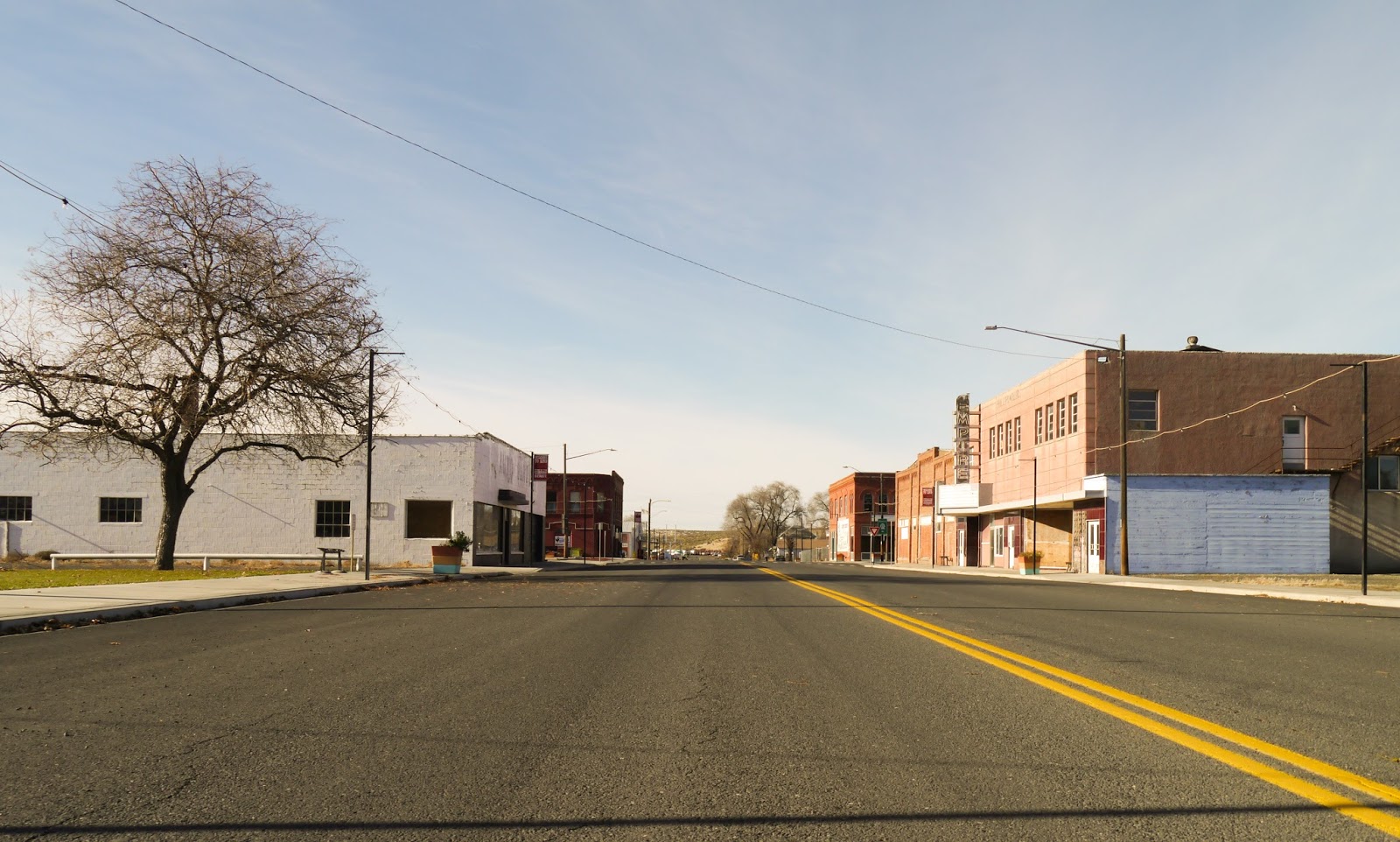
Lind: mid-day, mid-week, nothing moving


Palouse Falls, the Washington State Waterfall thanks to the enthusiasm of grades 3 – 6 at Washtucna Elementary School (so there’s life there, after all); the best waterfall, said Frank, he'd ever seen, including those in Alaska.  And one of the best kept secrets of Washington; don’t come near without diverting to see.


The fertile Palouse: rolling hills of top soil 40' deep
By contrast with those emptying towns, Walla Walla thrives, a community girded by a fine college and promoted by the burgeoning Washington wine industry.  The 21st C can be welcomed if one looks forward instead of longingly back.

Finally, Richland and Hanford – the towns that beat the Germans to the bomb.  The first and only test bomb, Trinity, was fueled with plutonium from the Hanford B reactor, as was poor Nagasaki’s bomb (an “alternative” target; what fateful vagaries of weather did wrought.)  Those scientists’ and engineers’ efforts, and subsequently my Dad’s, may have saved three million Japanese and American lives and held in abeyance a third World War, but also left us a legacy which Oppenheimer foresaw at Alamogordo: from the Bhagavad Gita, “I am become Death, the destroyer of worlds."  It took five years to bring Grand Coulee on line; thirty-five years and still counting to clean up our Hanford mess.  No Washingtonian should miss touring the B Reactor for it is our state’s enduring legacy of honor and dishonor. 


The Missoula floods, wheat, Grand Coulee, elevators and railroads, atomic physics and wine making, towns sadly hanging on, Lewis and Clark and trans-continental railroads -- The Larry Flock Memorial Road Trip was a trip of discovery and of great fellowship – a much needed reset.  Thank you, Bill, and Frank, and Rick – and Larry.