Tuesday, January 23, 2018

A Tale of Two Clocks — and of a Happy Gamble.


In 1806, Deacon Joe Waller ordered from Riley Whiting, a Winchester, Connecticut clock maker, the wooden works, pendulum, and weights for a long-case clock, a ‘grandfather’ clock.  He had made, or made himself, we don’t know which, a beautiful but rustic case of walnut, and thus was created “The Waller Clock” for his new farm in West Enosburgh, Vermont.  Joe, alongside his father Israel and brother David, had fought in the Revolutionary War with Ethan Allen’s Green Mountain Boys, when Vermont was not even a colony but only a rocky, hilly outback claimed by both New Hampshire and New York. The “Deacon” came about later, when he split from the Congregational Church he had helped found in Enosburgh Falls and decamped to a new Baptist church because, as he wrote, he “didn’t want to take communion with those who had merely been sprinkled.”  Deacon Joe is the longest living male in my direct Waller line, dying at 87 in 1852.
The Waller Clock

The clock passed down to Joe’s eldest son, Chester, and then in time to his son Henry.  By then, the family had moved on from Enosburgh Falls to Barton Landing, up in the “Lost Kingdom”, the far northeast corner of Vermont.

Henry died in the 1879/80 measles epidemic, at age 36.  His wife, Josephine, passed on 120 days later, of a broken heart people said.  Left behind were four boys, ages 1 through 7, the second of whom, Halley, aged four, grew into my Grandfather.  The orphans were parceled out to uncles and grandparents.  The orphaned Waller clock was taken in by Henry’s sister and disappeared from Waller view. 

Until 1935.  Then Halley got a call from a second cousin: the clock had been standing for over 50 years, unused, in a second bedroom of his Vermont farm house which was being put up for sale; “if you want it, come and get it.”  Grandpa drove out from Akron, Ohio and brought the Waller clock back into its proper family.

My son Frank had been hankering for the clock for a few years.  My Dad had passed it on to me before he died, and Frank seemed to see in that a recognition of independent adulthood, a senior rite of passage as it were. I began to empathize.

My talk of sending the clock off to Frank, in Champlin, Minnesota distressed Ann; she had become attached to the clock steadily tick-tocking away in our kitchen/sitting area.  I, on the other hand, thought Frank had a good idea and a good claim.  So how to mollify both?

Could I replicate the Waller Clock? I started idly checking auction houses on line. In December of 2016, I came upon an auction of clocks in Buffalo, New York; among the offerings was a “New England Tall Case Clock: early 19th C, butternut case, original painted dial, wooden works, time and strike calendar movement.”  The consignor claimed it operational; the auction house folks assured me that all the parts were there.  And the case looked good – at least in a small b&w photo on-line.  

Was I serious about this, about giving up  the Waller clock and replacing it with another?  This Federal-style clock was the first I had found on offer.  “What the hell”; I put in a ridiculous, low-ball bid, sight unseen.  In January, word came that I now owned a second grandfather clock – in Buffalo.  And I dared not tell Ann.

Licensed inter-state shippers bid twice or more what the clock cost, but the auction house led me to a gypsy shipper whom they trusted to handle antiques.  She gave me a good price and said that she could pick up the clock in January and probably would have a West Coast run by March or so.  Delivery was to Cypress Tree, in Redmond, our trusted furniture restorer and re-finisher.

January came and went; no pick-up.  No problem said the auction house; we’ll just hold it for you.  March came and went; neither pick-up nor delivery.  In April, the pick-up in Buffalo. In August, the delivery.  I went over to Cypress Tree to see what I had bought.  Good news: the black walnut (!) case  needed minimal work, and a missing finial could be reproduced.  Neutral news: while the second hand seemed original, the hour and minute hands, and one of the two weights, looked like more modern replacements, perhaps later 19th or early 20th C.  Bad news: the calendar was a dummy.  Not such bad news, really; they rarely worked anyway.

The works and dial were as advertised.  In fact, the works were virtually identical to the Waller Riley Whiting’s design and the apple wood gears and spindles looked as if they came from the same lathe under the same hand.  I suspect I have either an unsigned Riley Whiting or a Hoadly, a partner of Whiting’s who left to make his own clocks in 1813.  I commissioned Cypress Tree to lightly clean the dial; reproduce the missing finial;  tighten up, steam clean and wax the case; and hold the clock until we returned from Scotland.

In early October, Ann went into hospital for a knee replacement.  The next day the clock was delivered and the Waller clock wrestled downstairs.  I set the newby up where the Waller Clock had stood since 1991.  And it ran! – for 20 minutes.  Call to my old clock repairer: he no longer made house calls on long case clocks, but led me to Storm Smole, nee’ Austormius Josephus von Smoleans, trained in his family’s Austrian clock works founded 1729, and proprietor of  Edelweiss Time Company on Bainbridge Island.
 
In the meantime, Ann came home.  The next day she observed that “the clock has stopped.”  “Yes, I have a guy coming tomorrow.”  Storm came, admired and tinkered, and it ran again.  It chimed the hour; that was new, for the chime on the Waller clock had been decommissioned by my Dad long before as ill-fitting the dignity of the austere, tall case.  No mention from Ann at the new sounds ringing through the house every sixty minutes.
 
The Janes Clock
A week went by.  Sure, she was distracted by her knee recovery regimen,  but no notice of this new resident of our home.  A second week.  Then she asked why I had removed the door knob on the clock.  No, I hadn’t removed any knob: puzzlement.  Finally, more than two weeks after the replacement of the Waller clock: “something is different . . .”  I then introduced her to the Janes clock.

The Janes clock is a delight, happily tick-tocking away and once I learned its sensitivities, keeping accurate time.  The Waller clock, after careful encasement and shipment (read expensive) is now safely in its new home in Minnesota.  A new and challenging climate for a wood works clock – huge temperature and humidity swings – but not too unlike the conditions it lived in in Maryland and Ohio, though very different from those in Vermont.  But it will be happy there, at 212, and do well for generations of Wallers well into the 21st C, I am sure. 

And I?  I am one happy gambler!  

Wednesday, January 17, 2018

Holiday Positives

At our speaker’s club Thursday, the Topic Master spoke of the stress-free holiday he had enjoyed – clue: without family.  He recalled for us those strains and tensions of family holidays – the expectations, the shoulds and shouldn’ts, the pressures and judgments -- and how free of all that he felt this year.  There were empathetic nods around the table, so he challenged each of us to share a positive holiday memory, and the tales brought smiles all around.


My father was a challenging figure – a workaholic under the pressures of WWII and the Cold War that he had to deal with at the War Department and the AEC.  He also was a bit of a martinet, demanding at table that we three kids defend our views, use precise words, think clearly and logically.  It was how one raised a child, as he had been raised.
 
Later on, he learned to relax, long after I had left home. Until those later days, though, I lived in awe, admiration and respect, yearning for his approval and affection.

My younger sister is a poet.  Her poetry selections this year (her 23rd annual gift of her works that meet her standards) included one entitled My Father.  The long and poignant portrait of our Dad and her relationship with him included this stanza:
               My father was my model for approach/avoidance.
               He terrified me.  I dreaded/couldn’t wait,
               Until I heard him enter the house,
               Tall and smiling, or grim and cold,
               He was our own weather system.
               His mien cast the atmosphere.
               . . . .
She, the youngest, grew a close and loving relationship; he mellowed and she managed him better than did her older brother and sister.  We, on the other hand, had issues to resolve.  

But not at Christmas.  At every Christmas time, a boy emerged.  Dad loved the holidays -- the music, the lights, the fellowship.  He blocked out those “real world” tensions for a time and lavished his joy on all.  Christmas Eve and Morning were ceremonies of suspense, New Year’s day an open house for friends, neighbors and acquaintances – an open house with roaring fire, punch, often roast oysters and always pans of fin and haddie.

The first year after leaving the AEC and moving to private industry, in New York City, Mom and Dad rented a house in New Canaan.  It had a 16 foot living room ceiling – the boy’s Christmas dream.  He bought a 15’ tree.  Our stored decorations were at best for a 7’ tree; off to Gus’s Hardware for strings and strings of lights, cartons and cartons of bulbs and garlands – and, oh yes, a 12’ step ladder in order to place the stuff and put the sacred star atop the whole.  Christmas décor that year was a budget-buster for Mom.  (A once in a lifetime: the house they built and moved into the next year, and all subsequent houses, had but 8’ ceilings.)


So the Soltice Holidays were always positive and welcome in our home, not just for themselves, but because they cracked open the patriarch and let out that gentle Ohio boy, whom my Mother so loved, hidden inside.

Tuesday, December 26, 2017

My Best of '17

East of Dayton, WA; Nov.
British Columbia, June

Sleep-over Toes

Galena, Feb.

Nehalliston, BC, June

East of Cascades, Nov.

Washtucna, WA, Nov.

Walla Walla Fall

Hanford, B Pile

Spoonin'

Spring Coming to Rainier

Ketchum, June

Palouse Falls

Loch Maree

St. Margaret's Hope, Scotland, Sept.


Dark House, Lewis Island; Sept.
Rainy Day on Skye


Sleite, Scotland; Sept.

Eilean Dornan, Sept.

Glenfinnan, Sept.

Sterling, Sept.

Dunblane, Sept.


Friday, December 8, 2017

The Larry Flock Memorial Road Trip -- a Renewal

I have suffered awhile with bloggers block .  Not sure why.  PTSD (Post-Trumpian Shyster Distress?)  Perhaps.  Maybe my withdrawal from boards has sunk in, leaving me rootless with nothing but junk clogging my e-inbox.  More likely because the world’s problems, which I have already and ably solved so many times, have proved stubbornly resistant.  I think of Mark Twain protesting that stopping smoking was easy: “I’ve done it hundreds of times.” 

A humbled blogger speaks softly – if at all.

A reset was in order.  Best to get out of my space and learn something.  Friend Frank proposed the Larry Flock Memorial Road Trip -- just the thing!  In mid-November, four of us headed out into eastern Washington in memory of a friend who loved his road trips.  Best to think about Larry on the road, riding in his old Caddie with Joyce, than to take our leave in a formal memorial service.
 
The foray through rural and small town Washington was enlightening — another small step of confronting Fletch with the vastness of what he doesn’t know.  I’ve lived here in Cascadia for 32 years, longer by far than anywhere else.  But rural and small town Washington is alien to me, much of it lying east of the Cascades – a vast territory through which I have sped on I-90 or I-82 on my ways to afar, unaware of what drama lay outside the white striped channel of highway.

We crossed the Columbia near Vantage.  First stop: David Govedare’s Grandfather Cuts Loose the Ponies, his public art gift for the 1989 centenary of Washington's statehood.  

And then on up into the Grand Coulee -- through Ephrata, Soap Lake, Electric City to the fabled dam at Coulee City.  Bill explained how the Grand Coulee was carved at the end of the Ice Age by gargantuan floods released from Lake Missoula as its successive ice dams broke up.  The raging waters scoured through layers of basalt lava and poured over what is now Dry Falls, then the largest waterfall in the world; now she’s just biding her time, waiting to see what the next great climate turn will bring.

Until you stand by it, you can’t grasp the enormity of Grand Coulee Dam.  Ann and I have been re-reading Kearns, Caro and Dallek on LBJ.  Caro vividly portrays the dreary toil of farm life before electrification, cruelly hard on farm wives.  Grand Coulee Dam brought reprieve to countless families in Eastern Washington, and enabled the waters of the Columbia to make the desert bloom.  The dam was built in five years (!); today, projects a third the size take us three times longer.

Rectangular; precursor of  the cylindrical
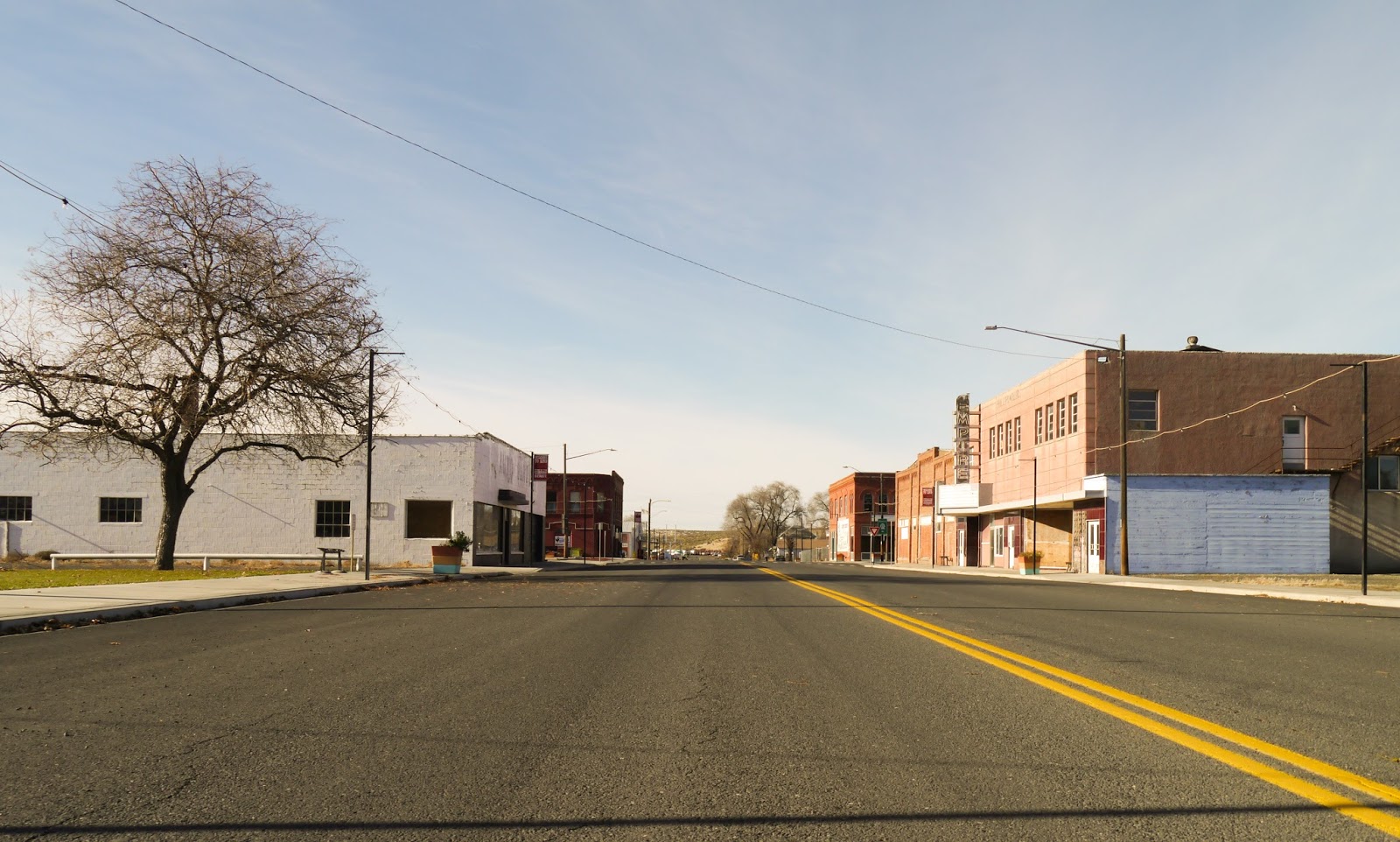
In the 19th C, if they could irrigate the desert, it was turned into wheat fields.  Elevators mushroomed up.  And railroads came.  Towns sprang into being – and then the railroads merged, failed, left.  So Lind stands idled, boarded up save for a dingy bar and run-down movie house, hanging on to the 21st C by its fingernails.  So with Dayton and Thorpe, Washtucna and Waitsburg – Waitsburg which briefly boasted more millionaire residents per capita than any other Washington town – and countless others, by-passed not just by railroads and Interstates but by the American Dream.  Rick briefed us on each in turn.  Those patriots who stay look back in longing for what once was.

Lind: mid-day, mid-week, nothing moving


Palouse Falls, the Washington State Waterfall thanks to the enthusiasm of grades 3 – 6 at Washtucna Elementary School (so there’s life there, after all); the best waterfall, said Frank, he'd ever seen, including those in Alaska.  And one of the best kept secrets of Washington; don’t come near without diverting to see.


The fertile Palouse: rolling hills of top soil 40' deep
By contrast with those emptying towns, Walla Walla thrives, a community girded by a fine college and promoted by the burgeoning Washington wine industry.  The 21st C can be welcomed if one looks forward instead of longingly back.

Finally, Richland and Hanford – the towns that beat the Germans to the bomb.  The first and only test bomb, Trinity, was fueled with plutonium from the Hanford B reactor, as was poor Nagasaki’s bomb (an “alternative” target; what fateful vagaries of weather did wrought.)  Those scientists’ and engineers’ efforts, and subsequently my Dad’s, may have saved three million Japanese and American lives and held in abeyance a third World War, but also left us a legacy which Oppenheimer foresaw at Alamogordo: from the Bhagavad Gita, “I am become Death, the destroyer of worlds."  It took five years to bring Grand Coulee on line; thirty-five years and still counting to clean up our Hanford mess.  No Washingtonian should miss touring the B Reactor for it is our state’s enduring legacy of honor and dishonor. 


The Missoula floods, wheat, Grand Coulee, elevators and railroads, atomic physics and wine making, towns sadly hanging on, Lewis and Clark and trans-continental railroads -- The Larry Flock Memorial Road Trip was a trip of discovery and of great fellowship – a much needed reset.  Thank you, Bill, and Frank, and Rick – and Larry.   

Monday, October 16, 2017

A 'Miann Leatsa, Alba (That’s Gaelic; I looked it up.)

Soon after arriving in Scotland in late August, Ann and my first stop was the national museum. I became aware that my antennae unconsciously were tuned to the issue of independence, for the tone of the displays was a subtle, sometimes not so, message that Scottish is separate from English.  I suppose my receptivity had to do with my granddaughter Liza’s devotion to Catalon independence and my long-standing support of Kurd self-determination.  Especially disturbing is Tillerson’s throwing support to the Iraqi Arabs and chastising the Iraqi Kurds who have been our steadfast allies ever since Desert Storm.  The Iraqi Arabs under al Maliki and the rest have been anything but steadfast, and Iran is egging them on.  Kirkuk is a dangerous flash point that can ignite region-wide, multi-national conflict; we have no policy or long-term vision of how the area might work through this.

The question of populist support for independence applies to lots of places.  If self-determination is one of our values, if independence is OK for Kurdistan and Catalonia, why not for California? Imagine, hypothetically, that after ten or so more years of a Trumpian/Bannonite administration, northern Californians vote for secession.  What might happen?  What would the US do?  And who might come to their aid? What’s to stop we in the “Soviet of Seattle” from declaring our intent to join them?

Anyway, back to Scotland (a pretty good place to get back to.)  We wandered about in northern Scotland’s Highlands, the Hebrides, the Orkneys, the moors and glens and lochs for over three weeks, never getting south of a line between Glasgow and Edinburgh.  I can’t say we came to know the country, but we did come to admire and respect it – and even, after a couple of weeks, came occasionally to understand a few words and phrases.

Their country is wild and beautiful, and the Scots are proud, resourceful, canny, and fierce friends when called on.  In every way, both subtle and direct, their message is that Scotland’s is a coherent culture, that Scotland has an identity and is a nation unto itself.  Yes, since 1706/07 it has been joined in the United Kingdom: that’s what the term means, the unity of Scotland with England, Wales, and, at that time, Ireland under a single parliament and one royal family.  But one gets the impression in their historical presentations and their discussions, in their pressure for federalism and devolution, that they regard themselves less a part of the United Kingdom and more as a “related kingdom.”

They voted down independence in 2014, 55% to 45%, but the driver was a strong affinity for the European Union and an assumption that, of course, the UK would remain in the EU.  Scotland voted 62% - 38% against Brexit, to remain in the EU, the most lop-sided majority of any of the British “countries”. Several Scots we talked with said they felt “betrayed” by England’s vote to leave and overwhelmed (England has 53 million people; Scotland one tenth of that, 5.3 millions.) But the 2014 independence campaign and 2016 Brexit referendum were strains on Scotch comity and unity; several with whom we talked counseled to forego for now another referendum – too disruptive, too divisive.  Better to wait and see how the Brexit negotiations play out and then put the question of independence again in four or five years.

There is little doubt our most of our few contacts would opt for independence rather than lose access to the European Union.  Only one fellow,  a grizzled, retired veteran of the Argyll and Sutherland Highlanders, expressed whole-hearted support for Union, i. e., the United Kingdom.  Reacting to my question of what would Scotland do for a defense force in case of independence he, standing before a portrait of young Queen Elizabeth in regimental colors, blurted out “by the Grace of God, not!”  But everyone else, the bartender, estate manager, game keeper, innkeeper, university student, foreign exchange student, immigrant and the rest strongly leaned toward independence.  Clearly, young Scots see their futures linked to easy access to Europe.  But all voiced the party line that better to wait than to rush into a new referendum.  

These pictures don’t portray independence, that aspiration, that state of mind,  but do show some of what endears us to Scotland. The north is a beautiful, austere land full of sheep and self-reliant souls.  This time of year it is chill, squally, wet and wonderful – a land of rainbows; we learned there is no bad weather, only inappropriate clothes. We ate haggis with breakfast eggs and porridge served with cream, brown sugar and single-malt on the side (I’ll never eat oatmeal again any other way.)    We wish the Scots well and independence, if that’s their wish, attained in a non-violent, civilized way of which both David Hume and Robert Burns would approve. 


A 'miann leatsa, Alba.  (That’s Gaelic; I looked it up.)

Thursday, October 12, 2017

Making America Less Great

While waiting for Ann to come out of the OR and the Recovery Unit, I began to daydream about becoming President.  

If he-who-shall-not-be-named has preempted Make America Great Again, what does that leave for an aspiring leader as I? (Sorry; must remember to look populist: ". . .like me.") Perhaps I could set about making America less great than ever.  Let's think, now, where would one start?

Well, I might consider unraveling our historical commitment to self-determination and being spokesperson for democracy.  To begin,  maybe embrace some autocrats, Putin, Erdogan, Duterte, Salman for starters, and invite some of the unseemly ones to the White House.  Erdogan and Rezak would be good candidates.  But just to keep people on their toes, I might also squabble with some others, such as Xi and Un and the Ayatollah.  

Second, tackle our reputation for trustworthiness.  We need a little doubt in the world.  What about revoking trade agreements and repudiating international pacts?  That Paris Accord would sow some good doubt and distrust, and NAFTA -- that would really shake things up.

And spread doubt here at home, too.  Maybe raise awareness of how far our infrastructure has been weakened by deferred maintenance -- and then do nothing at all about it.  Frustration is good for making folks think we're not so great as we used to be. 

And fear; fear is good.  Let's expand our nuke inventory and make some idle threats. And look unstable; instability puts people on edge. Let's show that FDR was wrong; we have lots to fear other than fear itself.

Third, I might push America further down in the world rankings of health -- more premature deaths, more addiction, less women's health support, less of a health-care safety net, the most expensive system in the world.  There must be ways to do that. 

Oh, and that equality ideal Jefferson kept writing about? (All the while sleeping with a female slave, using his power position to dominate a woman -- what a deal.) I guess we could give special benes for wealth and make sure the one tenth of one percent get even further ahead of the rest.  

Speaking of Jefferson, what about tolerance and religious freedom?  Perhaps embrace Christian Evangelicals who think they have the inside track on redemption, and teach Americans to be suspicious of non-Christians?

Golly, there's a lot one can do to Make-America-Less-Great-Than-Ever. And then arrange to get booted out of office and really polarize the country.  Can't wait to get started!


PS I know -- this isn't funny.  It’s damn serious!